
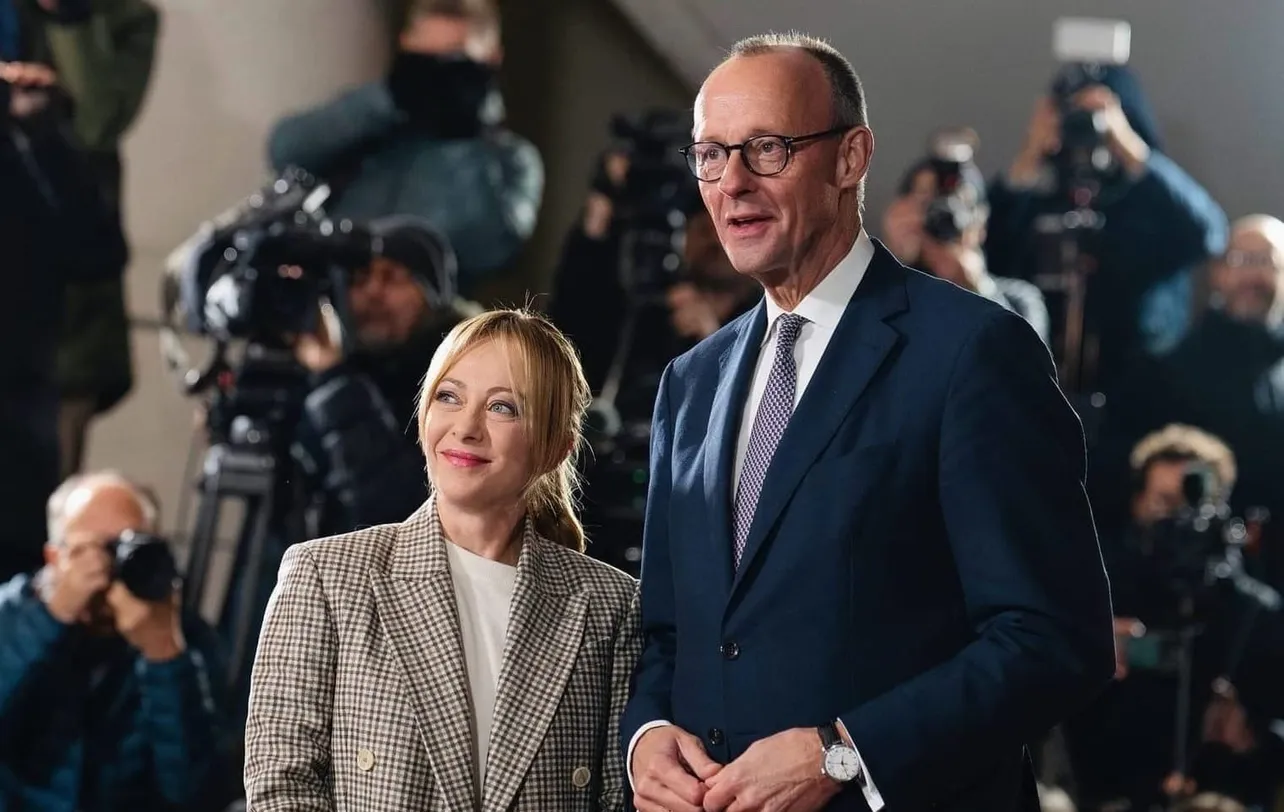
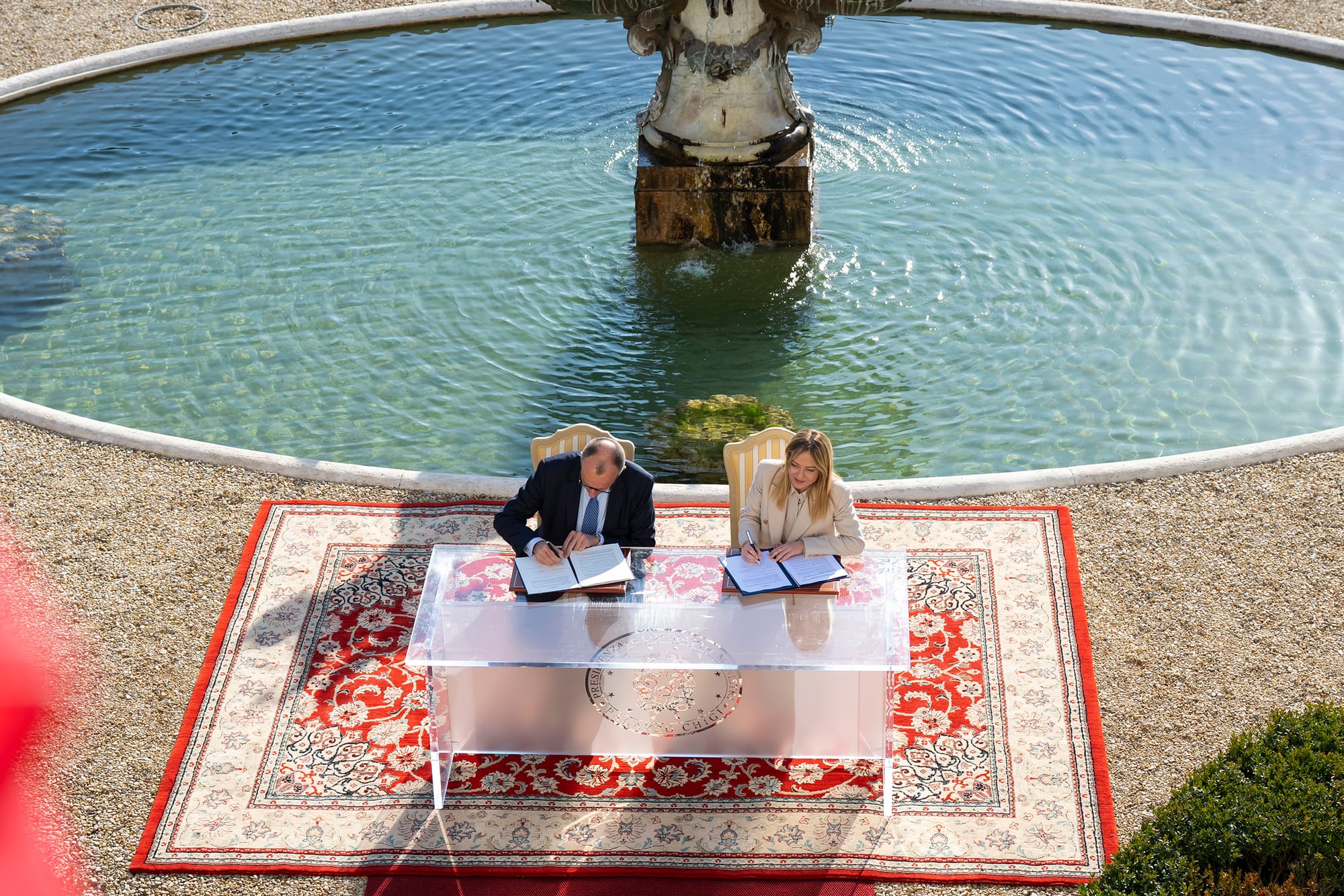
In recent months, German and Italian leaders have appeared together more frequently, signalling closer political alignment. This trend found concrete expression on January 23, 2026, when Chancellor Friedrich Merz and Prime Minister Giorgia Meloni signed a bilateral cooperation agreement in Rome. The agreement formalises closer coordination between two of Europe’s largest manufacturing economies across industrial, economic, and security policy.
It does not create a new alliance or replace EU or NATO structures. Instead, it shapes cooperation that already exists across industrial policy, supply chains, and defense production.
The System Under Strain
Until 2021, Germany and Italy operated within a European trade system that required little political coordination. Germany’s factories converted imported energy and materials into finished products — vehicles, machinery, chemicals, and industrial equipment — supported by a stable energy supply and predictable transport routes. Italy’s Mediterranean ports received raw materials and intermediate goods from global suppliers. Industrial clusters processed these into components and semi-finished products, which rail networks moved north into manufacturing hubs in Germany and elsewhere.
As long as these flows remained stable, procurement and logistics were handled at company level, while governments focused on maintaining general EU rules rather than managing individual supply chains.
From 2021 onward, this arrangement weakened. Russian gas supplies fell sharply, energy prices rose, and transport routes became exposed to geopolitical risk. Competition for key materials intensified, while delivery schedules became harder to maintain.
In this environment, attention shifted toward the physical parts of the supply chain linking entry, inland transport, and processing inside Europe. Germany and Italy plan to improve this flow and coordinate more closely on Geopolitical issues.
What Italy Is Building
As part of its broader industrial and infrastructure strategy, Italy has expanded investment to facilitate the movement of raw materials and intermediate goods into Europe andinland. The focus is on ports, rail corridors, and industrial zones where materials can be processed before reaching factories.
At several ports, capacity is being increased to allow larger vessels to enter and unload more consistently. In Genoa, a new outer breakwater is under construction farther offshore, reducing weather-related disruptions and enabling larger ships to operate more frequently. Shore power systems are being installed at multiple ports, with several projects scheduled for completion or delivery in 2025–2026, enabling ships to switch off their engines while docked and reducing time at berth.
Inland movement is being addressed in parallel. Several Italian ports, including Trieste, connect directly to rail corridors that meet TEN-T (Trans-European Transport Network) standards, allowing longer freight trains to move higher volumes north into European manufacturing regions. Road links support short-distance transport between ports, rail terminals, and nearby industrial zones.
Processing capacity is being concentrated along these routes. Rather than developing new standalone facilities, Italy is expanding activity in existing industrial sites where heavy industry, logistics, utilities, and permits are already in place. Portovesme in Sardinia, which relies on maritime access, and Porto Marghera near Venice are two such locations, both linked to ports and established transport networks.
At Portovesme, Glencore and Li-Cycle are advancing plans for a battery-recycling facility targeted to process 50,000–70,000 tonnes of battery black mass per year. The facility is intended to refine material containing nickel, cobalt, and lithium into battery-grade inputs, representing the first project of this scale in Europe and reducing the need to export battery materials for processing elsewhere.
Circular Materials plans a separate facility to treat around 20,000 tonnes of industrial wastewater annually, recovering more than 4,000 tonnes of metals such as nickel and copper for reuse. The INSPIREE project targets industrial-scale recovery of rare earth elements from discarded equipment and permanent magnets, with initial plants aiming to produce up to 700 tonnes per year of rare earths used in electric motors, sensors, and defence systems. At Porto Marghera, Versalis has opened a plant to produce plastics from recycled materials, expanding its processing operations within an established industrial zone.
These investments form part of Italy’s broader industrial and infrastructure strategy. While the Germany–Italy agreement does not name individual projects, the priorities set out in the documents reflect this direction.
Why This Works for Germany
Germany’s manufacturing base depends on steady access to processed inputs such as battery-grade metals, chemicals, plastics, and components delivered on predictable schedules. Assembly and integration remain the core of German industrial output.
Italy’s current developments shorten the distance between entry, processing, and use. Fewer steps depend on processing hubs outside Europe, reducing exposure to bottlenecks concentrated in a small number of countries. When materials are processed within Europe, delivery times and regulatory conditions become more consistent, and political risk is easier to assess.
The result is not self-sufficiency, but greater control over the most exposed parts of the supply chain. This logic underpins the economic dimension of the cooperation and explains why infrastructure, processing, and industrial policy are treated together rather than as separate domains.
Geopolitics — Why the Agreement Matters Beyond Economics
The agreement also reflects a changing security environment. For both Germany and Italy, Russia’s war against Ukraine remains the central strategic issue. Berlin and Rome continue to support Ukraine through military assistance, sanctions enforcement, and commitments to long-term reconstruction.
The war has placed sustained pressure on European defence production. Ammunition, air defence systems, drones, spare parts, and maintenance capacity have become persistent constraints rather than episodic requirements. This has highlighted how defence equipment is designed, supplied, and sustained over time.
The Germany–Italy cooperation links industrial capacity more closely to these security demands.
From Parallel Industries to Coordinated Production
Germany and Italy developed their defence-industrial bases largely in parallel. Germany focused on land systems, armoured vehicles, sensors, electronics, and logistics-intensive platforms. Italy concentrated on naval construction, aerospace, electronics, and dual-use manufacturing with a strong export orientation. Both relied on extended supplier networks spread across Europe.
The agreement does not combine these industries. It connects them by aligning specifications and sustaining production where possible.
A first step is early coordination of military requirements. Instead of issuing separate technical specifications, both countries align operational needs before systems are designed or ordered. This allows shared design baselines, interchangeable components, and coordinated upgrades within existing NATO and EU frameworks.
The outcome is interoperability rather than uniformity — systems that can operate together and be maintained together under sustained use.
From Production to Deployment
Coordination depends on procurement. The agreement relies on existing European mechanisms, including OCCAR (Organisation for Joint Armament Co-operation), to manage joint development, upgrades, and shared production. Areas identified for deeper cooperation include unmanned systems, air and missile defence, electronic warfare, naval combat systems and submarines, and sensors such as optronics and naval radar.
Demand handling is central. Instead of separate national orders, the emphasis is on bundling demand and coordinating upgrades. Shared orders support production continuity and stabilise supplier networks.
A practical instrument in this process is the bilateral defence-industry roundtable, with the first scheduled in Rome in the first half of 2026. Defence ministries identify capability gaps, industry presents mature systems or upgrade paths, and procurement agencies assess where joint orders or shared sustainment are feasible. The focus is on execution rather than declaration.
Deployment depends on mobility. The agreement emphasizes dual-use infrastructure—ports, railways, roads, and airfields that can support military movement during a crisis.
A key focus is the main north–south corridors linking Italian Mediterranean ports to Germany through the Alps. Making this corridor usable under stress requires addressing load limits, train length, port handling capacity, and border procedures in advance.
This improves Germany’s access to the Mediterranean while allowing Italy to anchor logistical depth on the southern flank. The approach relies on rotational access, joint exercises, and contingency planning rather than permanent basing.
Italy’s geography extends the cooperation beyond central Europe. Proximity to North Africa, the Eastern Mediterranean, and major maritime routes allows joint engagement on maritime security, protection of undersea infrastructure, and crisis response related to energy routes, migration, and hybrid threats. Germany contributes logistics scale and surveillance capacity, while Italy provides access and operating depth.
The framework remains cautious. Its effectiveness will be judged by contract performance, sustained production, and the ability to deploy forces as required.
Conclusion
The Germany–Italy agreement does not establish a new alliance or alter Europe’s balance of power. It reflects a shift in how economic capacity, infrastructure, and security are handled under pressure.
Germany anchors downstream production and industrial scale. Italy anchors access, movement, and geographic reach. The cooperation links these roles without duplicating EU or NATO structures and without aiming for self-sufficiency.
Its significance lies in execution. If infrastructure upgrades, industrial coordination, and military mobility translate into sustained practice, the agreement becomes part of Europe’s operating reality rather than a political gesture.
In a more volatile environment, that functionality matters.