
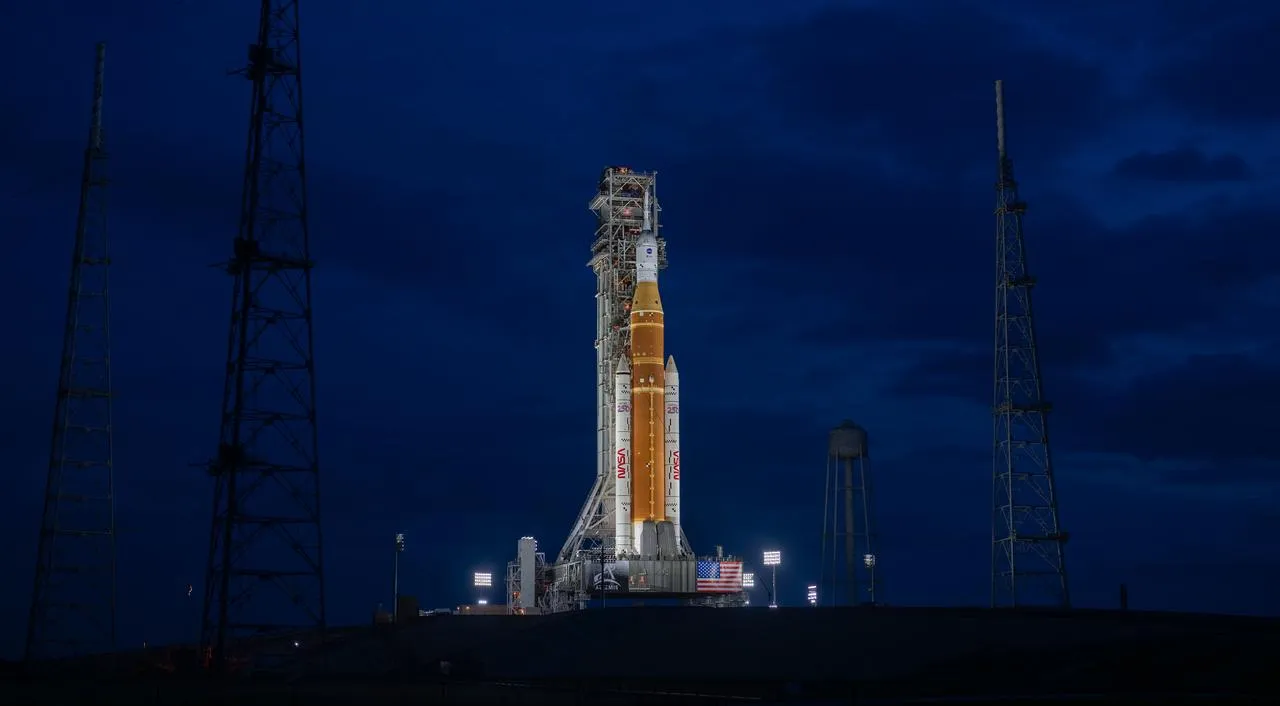
In March 2026, NASA held its "Ignition" event, outlining a structured plan to return astronauts to the Moon and establish a permanent surface presence. The announcement came as China accelerated its own lunar timeline toward a crewed landing around 2030, with both nations targeting the lunar south pole — a region believed to contain water ice and where only a limited number of locations are suitable for operations.
What NASA outlined at Ignition is not a single mission but a phased build-out. The plan moves from robotic deployments and technology testing toward regular crewed landings, surface infrastructure, and eventually a continuous human presence on the Moon.
Artemis II, a crewed lunar flyby scheduled for April 2026, marks the first human mission of this phase and the immediate step before surface operations.
The Space Economy
The global space economy is currently valued at around $613 billion and is expected to rach 1 trillion by the early 2030s. Most of that activity takes place in Earth orbit, where satellites provide communication, navigation, and security-related functions for. Launch systems place those satellites into orbit to support services on Earth.
Lunar activity forms a separate and much smaller layer. As of now it is largely driven by public funding and organised around individual missions and hardware contracts, with missions remaining infrequent and limited in scope.
Growth in the lunar segment depends on one condition: missions must become regular and sustained. NASA’s plans outlined at the Ignition event are designed to make that shift — moving lunar activity from occasional missions toward regular operations through a phased build-out of surface infrastructure and increased mission cadence.
NASA already works with commercial partners in this environment. SpaceX and Blue Origin are developing human landing systems, while Intuitive Machines and Firefly Aerospace deliver robotic surface missions through the Commercial Lunar Payload Services (CLPS) programme.
Launched in 2018, CLPS allows NASA to purchase end-to-end robotic delivery missions from private U.S. companies rather than building and operating landers itself. From a pool of 13 eligible companies, NASA supplies the instruments and technology payloads, while contractors handle integration, launch, landing, and surface operations.
In March 2026, Intuitive Machines received a $180.4 million CLPS task order for its Nova-D lander to deliver seven payloads to the lunar south pole region. NASA is now accelerating the programme, with plans for higher robotic mission cadence starting in 2027 under the follow-on CLPS 2.0 framework.
Infrastructure and the Phased Build-Out
NASA structures the lunar programme in three phases, each adding capability on the surface and increasing the level of activity over time.
The first phase focuses on robotic missions. Landers, rovers, instruments, and technology systems are sent to the surface to test how equipment operates under real lunar conditions — mobility, power generation, communication, and navigation. The emphasis is on repeated deployments rather than single demonstrations, with each mission expanding the technical base.
The second phase introduces early infrastructure and regular crewed missions. Astronauts return to the Moon and operate alongside rovers and temporary surface modules, with systems added incrementally to extend both the duration and frequency of visits.
The third phase delivers larger infrastructure using cargo-capable landing systems — habitats, mobility systems, and the logistics required to support a continuous human presence. Mission cadence initially targets crewed landings every six months, running in parallel with accelerated robotic deliveries.
The agency is also developing nuclear power systems for environments where solar generation is limited, particularly in the permanently shadowed regions near the poles where water ice is concentrated.
Alongside the surface build-out, NASA has restructured the broader programme architecture. Gateway, the planned orbital station, has been paused in its current form. The focus has shifted to surface infrastructure supported by commercially procured and reusable systems — a model that prioritises activity on the ground over orbital staging.
The Moon Before Mars
NASA's stated long-term objective extends beyond the Moon. Mars remains the programme's horizon, and the sustained lunar presence is structured as the step that makes it reachable.
The logic is practical. The Moon is close enough to allow repeated missions within manageable timeframes. Systems can be tested, adjusted, and qualified under real conditions before they are committed to a mission that takes months to reach and offers no opportunity for resupply or rapid intervention. Every element of a Mars mission — life support, surface mobility, power generation, resource extraction — can be developed and validated on the Moon first.
That proximity also changes the economics. Missions to the Moon can be run frequently, failures can be corrected, and systems can be iterated. None of that is possible at greater distances such as Mars.
Resources and Local Supply
The Moon contains materials that are directly relevant to sustaining operations on the surface. The most significant is water ice, identified in permanently shadowed craters near the lunar poles. Water can be separated into hydrogen and oxygen, providing a local source of fuel and breathable air.
The lunar surface also contains metals such as iron, aluminium, and titanium, which can be used for construction and infrastructure on the Moon itself. Together, these resources reduce the volume of supplies that need to be transported from Earth.
Other materials, including helium-3, have been identified in research as potentially significant. Helium-3 has been studied as a fuel source for fusion energy, though practical extraction and use depend on technologies that are not yet operational. Its relevance remains a long-term consideration rather than a near-term factor in programme planning.
The importance of these resources scales with the level of activity on the surface. Without sustained operations, they remain objects of study. With regular missions and infrastructure in place, they become part of the supply chain, supporting longer, more frequent, and more independent missions.
The Competitive Context
NASA’s decision to focus on the Moon was also shaped by China’s activity. China has been running a structured lunar programme through its Chang’e missions for over a decade. It has completed multiple robotic landings, conducted operations on the far side of the Moon, and returned samples to Earth. The next step is a crewed landing around 2030, followed by the build-out of a long-term base.
That base is planned as the International Lunar Research Station, developed with Russia and a group of partner nations. The programme follows a phased structure, moving from robotic missions toward surface infrastructure and extended stays through the 2030s. Russia contributes to the ILRS framework as a partner, though its independent lunar programme has been limited in recent years.
Both the United States and China are focused on the lunar south pole. The region is of interest for its water ice deposits, but also because the number of flat, sunlit areas suitable for landing and operating is small. Early infrastructure placed in these locations shapes which sites are accessible to subsequent missions. Nations that establish a presence first determine how that limited geography is used.
The United States is coordinating its programme through the Artemis Accords, a framework covering cooperation, data sharing, and operational conduct in space. Current signatories include the United Kingdom, Japan, Canada, Germany, France, Italy, Australia, and the United Arab Emirates, among others.
China and Russia are building their programme through the ILRS with a separate group of partners. Neither framework establishes ownership over any part of the Moon. Both shape how activity on the surface is organised. As infrastructure accumulates at the south pole, the decisions made in the current phase will determine how access to those sites develops over time.
Conclusion
The shift underway in lunar exploration is not defined by any single mission. It is defined by the move toward repeated operations and infrastructure that persists between visits.
NASA's programme is structured so that each mission builds on the last — capability accumulates on the surface, and activity becomes continuous rather than episodic. China is advancing toward the same model through a parallel programme, with both nations targeting the same limited set of locations at the lunar south pole.
If sustained, this approach changes what the Moon represents. It moves from a destination for exploration to a location where infrastructure is established, resources are drawn on, and operations are extended over time — forming the first operational layer of human activity beyond Earth orbit.