
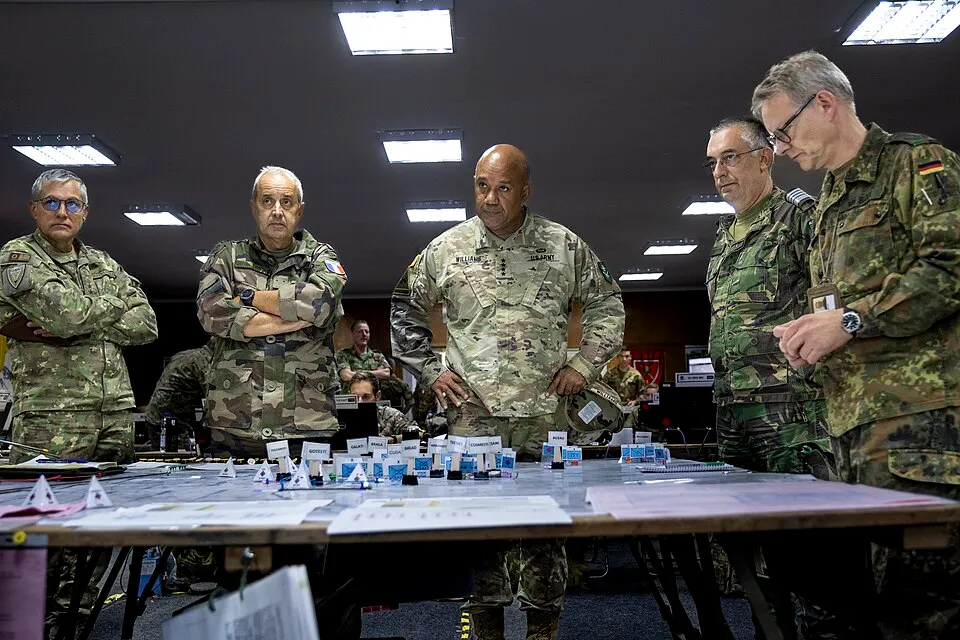
Mission Command, also known as Auftragstaktik in German, is a command philosophy used across NATO and most Western armies.
It gives soldiers freedom to act once the goal is clear. Commanders set what must be achieved and trust those on the ground to decide how to accomplish it.
This keeps operations moving when radios fail or conditions change more quickly than orders can be processed.
The concept was developed in 19th-century Prussia through Carl von Clausewitz’s study of friction and Helmuth von Moltke’s reforms.
Frederick the Great — The Prussian Foundation
In the mid-18th century, Frederick the Great turned a small Prussia into one of Europe’s major powers.
He built a disciplined army through constant drills, fast movement, and a focus on purpose rather than blind obedience.
Frederick wanted officers who could think, not just follow orders. When plans fell apart, they were expected to act on their intent and restore momentum.
His victories at Leuthen and Rossbach became famous for their speed and coordination.
That culture — of preparation, control, and intelligent initiative — laid the ground for the doctrine that Clausewitz and Moltke later refined.
Clausewitz — Naming the Problem: Friction
After Prussia’s defeat by Napoleon in 1806, Carl von Clausewitz studied why well-made plans often failed in battle.
He described friction: the many small problems — delayed messages, poor maps, weather, fatigue, and fear — that turn simple tasks into difficult ones.
He also described the fog of war: the uncertainty that clouds every decision.
Clausewitz argued that friction cannot be removed. The only solution is to maintain a clear goal and act despite it.
That requires strength of character and leadership through intent, not micromanagement.
Clausewitz defined the condition that any command system must solve.
Moltke — turning theory into a method (Auftragstaktik)
About forty years later, Helmuth von Moltke the Elder, Chief of the Prussian General Staff, made Clausewitz’s philosophy practical.
His famous statement — “No plan survives first contact with the enemy” — paraphrased Clausewitz’s warning about friction.
By the mid-nineteenth century, warfare had outgrown detailed control from distant headquarters.
Telegraph lines could not keep pace with the movement of armies, and new firepower multiplied the uncertainty.
Moltke’s innovation was to turn Clausewitz’s insight into a command method — decentralizing execution so operations could continue when friction made control impossible.
His answer was Auftragstaktik — mission-type tactics.
Higher command defined what must be achieved; subordinates decided how to achieve it when orders no longer matched conditions on the ground.
Officers were educated to think for themselves and to keep momentum when communications failed.
Moltke applied this method in the wars of 1864, 1866, and 1870–71.
With German unification in 1871, Auftragstaktik had become the core of Prussian doctrine.
World War I — doctrine under strain
By 1914, Auftragstaktik was embedded in the German General Staff system.
Trench warfare then limited movement and rewarded massed fire.
Even so, the principle survived on a small scale: late-war assault units (Stoßtruppen) employed local initiative — bypassing strongpoints and exploiting gaps — within a broader strategic intent.
The larger strategy stayed rigid and costly, but the habit of acting on intent endured into the interwar years.
World War II — speed, scarcity, and the roots of Blitzkrieg
In 1933–34, the Wehrmacht codified mission-type command in Truppenführung (HDv 300): orders should state only what is essential, and leaders at every level are expected to use independent judgment to carry out the commander’s intent.
Radios, tanks, and aircraft now made operations far faster than any headquarters could direct in real time.
Heinz Guderian argued for rapid, mechanized action guided by intent rather than step-by-step control; radio-equipped units could change routes, exploit gaps, and coordinate fires faster than opponents waiting for new orders.
Bundeswehr historian Karl-Heinz Frieser argues that Auftragstaktik supplied the command culture that enabled what we call Blitzkrieg once radios, tanks, and aircraft made speed possible.
Robert Citino adds that in Germany’s case, scarcity — fuel, time, and manpower — pushed commanders to turn speed of thought into speed of movement.
Critics such as Adam Tooze and Richard Overy reverse the perspective.
They argue that Blitzkrieg was not planned brilliance but forced improvisation—an attempt to win quickly before economic limits and supply shortages took hold.
Yet even they acknowledge that Auftragstaktik gave Germany the flexibility to act effectively under pressure.
Scarcity may have dictated the need for speed, but Auftragstaktik made that speed workable.
Post-1945 — continuity in the Bundeswehr
The Federal Republic of Germany founded the Bundeswehr in 1955 and re-anchored Auftragstaktik under Innere Führung (1956): initiative linked to law and democratic responsibility.
Today, ZDv 10/1 still calls Auftragstaktik a binding principle of leadership.
German officers carried this approach into NATO’s training culture.
U.S. adoption — from study to doctrine
After 1945, the U.S. Army analyzed why German formations often recovered faster from confusion.
Through the Foreign Military Studies Program (1945–1961), former Wehrmacht officers wrote thousands of reports for the U.S. Army Historical Division.
A recurrent conclusion: commanders at every level acted on intent, not constant orders.
During the Cold War, the U.S. built this idea into its own doctrine.
With AirLand Battle, the U.S. Army’s FM 100-5 (1982) emphasized mission orders and the greatest possible freedom for subordinates; by the 1993 edition, it explicitly paired “mission orders” with “decentralized execution.”
The U.S. Army later formalized Mission Command in ADP 6-0 as “the exercise of authority and direction by commanders using mission orders to enable disciplined initiative within the commander’s intent.”
British evolution — initiative in the field
After Suez (1956) and a series of dispersed operations, the British Army moved toward the same solution: freedom of action within clear intent.
The British Military Doctrine (1987) first formalized “mission command.”
Today, JDP 0-01.1 describes it as a philosophy that promotes freedom of action and initiative within clearly defined intentions.
Field Marshal Nigel Bagnall captured the aim: not loose control, but intelligent initiative.
NATO standardization
NATO combined national traditions into one alliance philosophy.
AJP-01 defines command as based on trust, mutual understanding, and clear intent — centralized purpose with decentralized execution.
In practice, multinational battlegroups operate this way: framework nations set intent; units solve local problems within that intent.
Criticism and practice
Adoption is easier than application.
Analysts note recurring gaps: digital tools tempt micromanagement; bureaucracy slows decisions; national caveats limit autonomy in coalitions.
Some call the result “micro-mission command” — intent in theory, central control in practice.
Yet no major Western military has dropped the philosophy, because waiting for perfect information does not work in real operations.
How it is taught today
Mission Command is trained, not declared.
Staff colleges and field exercises practice degraded communications, time pressure, and changing tasks.
Decision games and red-teaming force officers to act with incomplete information.
Rehearsals build shared mental models so that, when plans fail, everyone still understands the purpose and priorities.
The habit is simple: define the goal clearly, push judgment to the edge, keep moving when the plan breaks.
Mission Command 2.0 — human intent, machine speed
The principle has not changed: humans set intent; those closest to the action decide how to achieve it.
What is changing is who can decide and how fast.
Autonomous systems — drones, uncrewed aircraft, and AI-assisted platforms — operate in milliseconds and must act when communications are jammed or delayed.
Military researchers describe this evolution as Mission Command 2.0: human intent remains the foundation; execution is increasingly shared with intelligent systems that act within that intent.
The U.S. Army War College outlined this shift in Parameters (2017), arguing that data-dense, fast environments demand “greater trust, transparency, and disciplined initiative across human–machine teams.”
A 2025 RAND study similarly concludes that mission command will remain central to effective human–machine teaming because AI still requires clear objectives and human framing.
In industry and service trials, Shield AI’s Hivemind software lets autonomous aircraft fly and coordinate alongside crewed jets — even with degraded communications — executing commander’s intent as predefined; related U.S. Air Force efforts under Collaborative Combat Aircraft (CCA) test human pilots leading AI “wingmen” that adapt routes and tasks within mission parameters.
Conclusion — leadership under pressure
From Frederick’s culture of disciplined judgment to Clausewitz’s friction, from Moltke’s mission-type orders to NATO’s doctrine, the logic is constant.
Clarity of purpose and freedom of action turn uncertainty from paralysis into movement.
Technology changes — from couriers to radios to neural networks — but the core remains: when certainty disappears, intent and initiative keep a force alive.
Sources and further reading
Carl von Clausewitz, On War (1832)
Helmuth von Moltke (the Elder), Militärische Werke; campaign studies 1864/66/70–71
Truppenführung (Heeresdienstvorschrift 300, 1933–34), §§6–7
Heinz Guderian, Achtung – Panzer! (1937)
Karl-Heinz Frieser, The Blitzkrieg Legend (Oxford University Press, 2005)
Robert M. Citino, The German Way of War (University Press of Kansas, 2012)
Adam Tooze, The Wages of Destruction (Penguin, 2006)
Richard Overy, Why the Allies Won (Norton, 1995)
Bundeswehr, ZDv 10/1 Innere Führung (current)
U.S. Army Historical Division, Foreign Military Studies Program (1945–1961)
U.S. Army, FM 100-5 Operations (1982; 1993)
U.S. Army, ADP 6-0 Mission Command (2012; updated 2022)
UK MoD, British Military Doctrine (1987); JDP 0-01.1 UK Defence Doctrine (current)
NATO, AJP-01 Allied Joint Doctrine (current)
Anthony King, The Combat Soldier (Oxford University Press, 2013)
RAND Corporation, An AI Revolution in Military Affairs (2025)
U.S. Army War College Press, “Mission Command 2.0” (Parameters, 2017)
Association of the U.S. Army, Land Warfare Paper 132 (2020)
Defense News reporting on Shield AI and CCA programs (2025)