
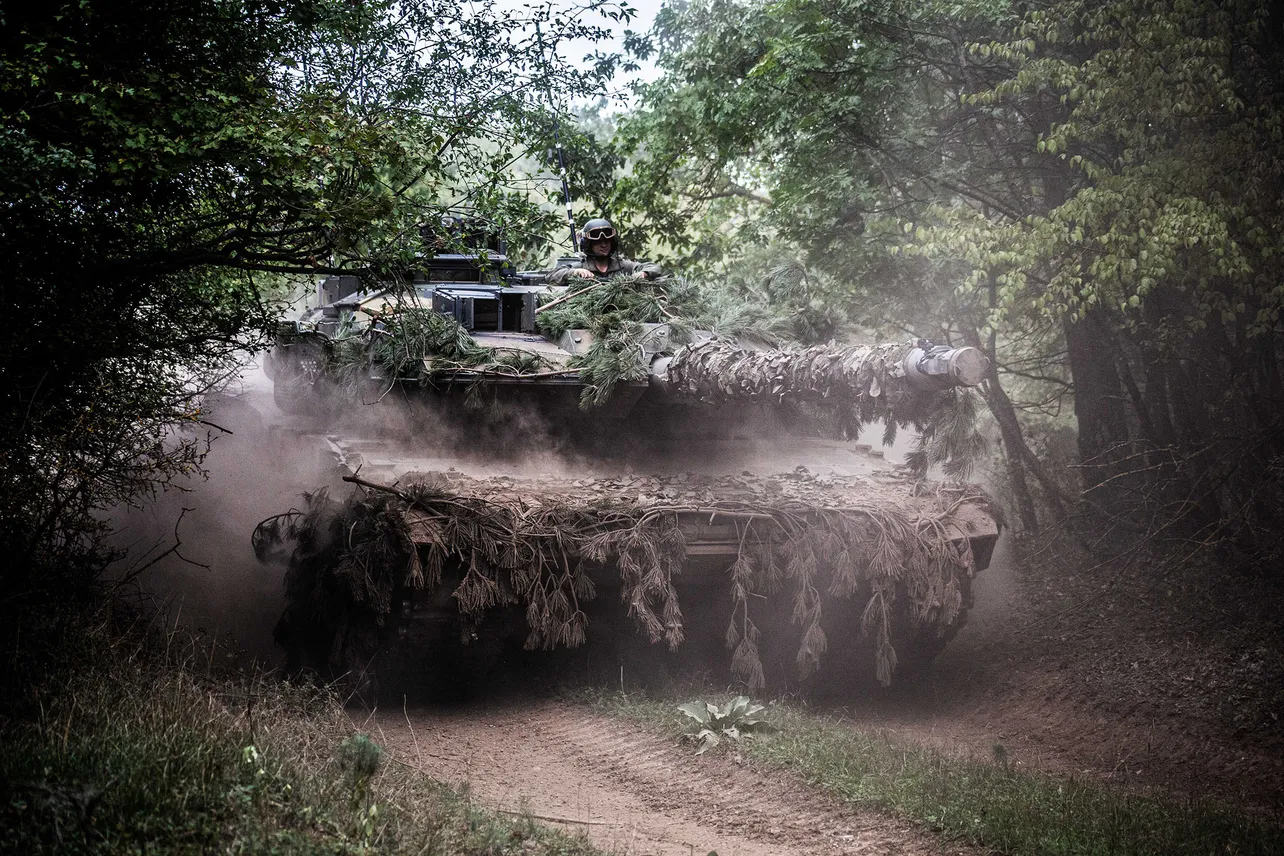
How NATO’s forward land forces are built, led, and deployed
Definition
NATO’s multinational battlegroups are combat-ready land formations composed of troops from several Allied nations, deployed on a persistent defensive basis across the eastern flank. They exist to deter aggression and, if required, to fight as the first line of defense. Each is led by a framework nation and joined by contributing Allies under NATO command. Their mission, as summarized, is to defend forward, integrate rapidly, and enable reinforcement.
Locations
As of 2025, NATO fields eight battlegroups, stationed in Estonia, Latvia, Lithuania, Poland, Slovakia, Hungary, Romania, and Bulgaria. Together, they form a continuous defensive arc from the Baltic to the Black Sea. The posture grew from four battlegroups after 2016 and expanded to eight in 2022.
Structure
Each battlegroup follows the Framework Nation Model. That means:
- The Framework Nation provides command, control, logistics, and core combat elements.
- The Host Nation is the country where the battlegroup is stationed—it provides territory, infrastructure, and national support.
- Other Allies contribute companies, enablers, or specialized units.
Combined, they form an integrated battalion-sized force, operating under NATO’s Allied Command Operations (ACO).
| Host Nation | Framework Nation | Role |
|---|---|---|
| Estonia | United Kingdom | Baltic defence |
| Latvia | Canada | Northern sector |
| Lithuania | Germany | Central Baltic |
| Poland | United States | Northeastern front |
| Slovakia | Spain | Central Europe |
| Hungary | Hungary | Central support |
| Romania | France | Black Sea flank |
| Bulgaria | Italy | Southeastern flank |
Table: NATO eFP Battlegroups, 2025. Roles are descriptive, based on NATO’s strategic positioning
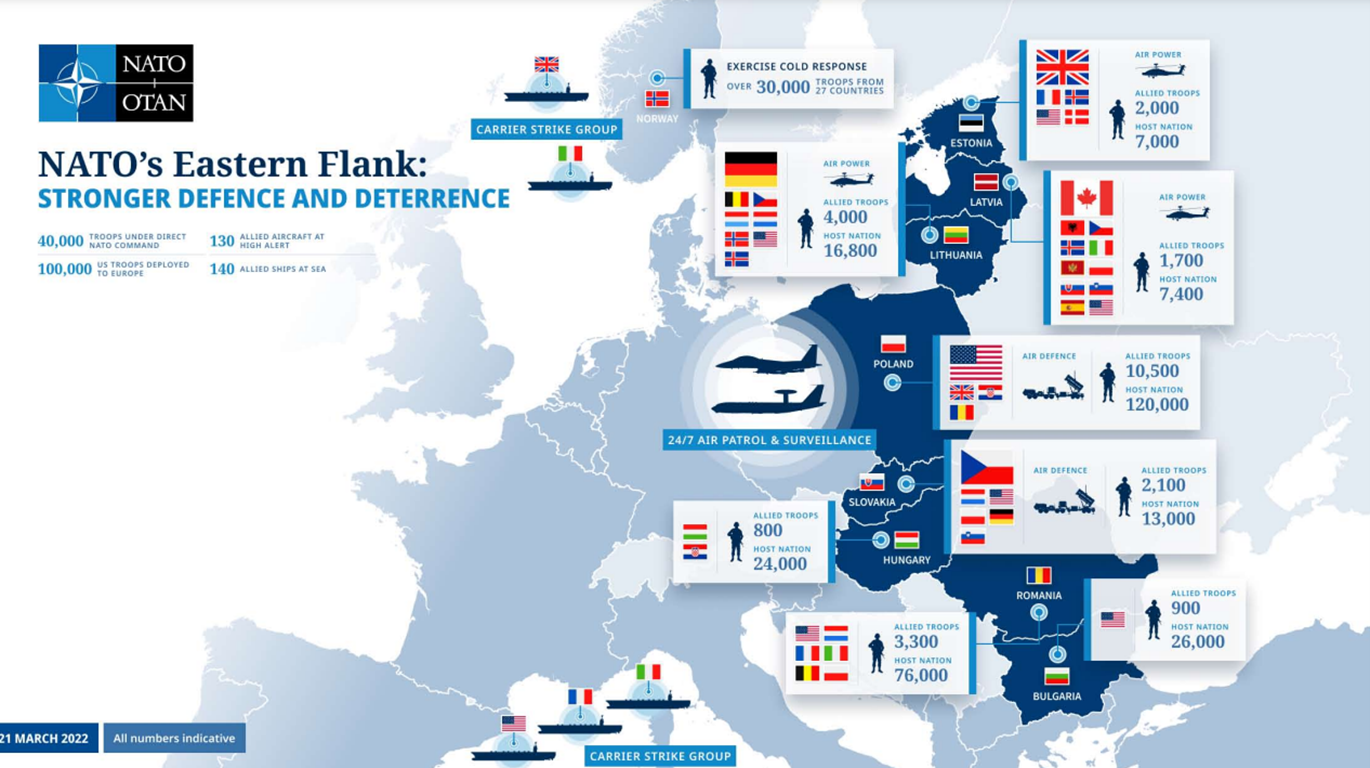
These are standing NATO units, not ad hoc coalitions, and they train to common Allied standards through regular certification cycles.
Purpose
Their role is deterrence by presence and defence by readiness. By stationing Allied forces in frontline states, NATO demonstrates commitment and raises the threshold for any attack. If deterrence fails, battlegroups fight immediately, holding ground while reinforcements deploy as part of NATO’s broader deterrence and defence posture.
Scalability
After the 2022 Madrid Summit, Allies agreed to scale battlegroups to brigade level when needed. The concept is modular: each can rapidly expand through reinforcements from the same framework nation or nearby Allies. Recent examples include brigade-level development in Slovakia and Latvia.
Command and Doctrine
Battlegroups operate through NATO’s integrated chain of command—from SHAPE at the strategic level, to LANDCOM and regional corps, down to local HQs. They follow Allied Joint Doctrine (AJP-01), which is built on mission command: commanders express intent, and subordinates act with initiative within that intent—enabling decentralized execution in multinational formations.
Integration
Cooperation is achieved through standardized procedures (logistics, communications, medical), multinational exercises that test combined-arms manoeuvre and live-fire operations, and regular evaluations ensuring interoperability across Allies.
Continuous Adaptation
NATO continually tests and refines the model through major exercises that rehearse reinforcement, air-land integration, and sustainment—confirming readiness and strengthening speed, cohesion, and resilience.
Critics and Operational Questions
While NATO presents the battlegroups as a proven deterrent, defence analysts highlight several operational questions. They note that each unit, though capable, is limited in size, and that scaling to brigade strength under combat pressure remains unproven in wartime. Others point to the complexity of multinational commands (different national rules/caveats and operations within host-nation sovereignty) and sustainment frictions across multiple logistics systems. In short, critics judge the concept sound in doctrine, but its wartime effectiveness hinges on how fast NATO can reinforce, resupply, and fight as one.
In essence, NATO’s multinational battlegroups are forward-integrated defensive formations—multinational in composition, doctrinally unified, scalable in size, and positioned to respond first if deterrence fails.
Sources
Official NATO / SHAPE
- NATO factsheet: NATO’s Forward Presence (eFP) — scope and eight host nations. NATO
- NATO topics: Deterrence and defence, Readiness Action Plan / 2022 decisions. NATO
- JFC Brunssum (ACO component): Mission/battlegroups under ACO.
- SHAPE eFP: Present structure & national roles; updates on Poland/Romania/Bulgaria. NATO Shape+2NATO Shape+2
- Allied Land Command (LANDCOM): eFP overview; exercises/readiness; Latvia scale-up. NATO LC+2NATO LC+2
- ACT (Allied Command Transformation): Mission command emphasis in future C2. NATO ACT
- AJP-01 reference mentions within NATO docs (Capstone Doctrine). NATO Shape
Critics / analytical perspectives (as requested)
- CSIS — Designing New Battlegroups: Advice for NATO Planners (force design, reinforcement, sustainment). CSIS
- CSIS — Is NATO Ready for War? (readiness, scaling, logistics/industry). CSIS
- War on the Rocks — NATO’s Presence in the East: Necessary but Still Not Sufficient (tripwire vs defence, command frictions). War on the Rocks
- Wilson Center — The Evolving ‘Tripwire’ on NATO’s Eastern Flank (tripwire concept, deterrence credibility). Wilson Center