
Recent tensions in the Middle East have once again drawn attention to the Persian Gulf and its role in the global energy system. Events in the region can quickly affect shipping routes, energy markets, and international trade.
Much of this attention focuses on the Strait of Hormuz and the possibility of disruptions to maritime traffic. The narrow passage has long been recognised as one of the most sensitive points in the global energy network.
At the same time, the Strait of Hormuz is only one part of a much larger system. Energy produced around the Persian Gulf moves through a series of interconnected stages before reaching international markets, linking production areas in the region with global shipping routes.
Energy Resources and Production
The Persian Gulf region hosts one of the largest concentrations of oil and natural gas production in the global energy system. Saudi Arabia, Iraq, Iran, the United Arab Emirates, Kuwait, and Qatar form the core of this production cluster.
Saudi Arabia leads regional oil output and operates some of the largest oil fields ever discovered. Key fields include Ghawar, the largest conventional oil field in the world, and Safaniya, the world’s largest offshore oil field.
Iraq’s production is concentrated in large southern fields such as Rumaila and West Qurna, which together account for a significant share of the country’s output. Iran also operates several giant fields in the southwest of the country, including Ahvaz, Gachsaran, and Marun, which rank among the largest producing areas in the region.
In the United Arab Emirates, most oil production comes from fields in Abu Dhabi, including the Zakum field, one of the world’s largest offshore oil field complexes. Kuwait’s production is centred on the Burgan field, another of the largest oil fields ever discovered.
Natural gas production in the region is dominated by the North Field–South Pars reserve, which Qatar shares with Iran beneath the waters of the Persian Gulf. This giant reservoir is the largest known natural gas field in the world and forms the foundation of Qatar’s liquefied natural gas industry.
Under normal conditions, roughly 20 to 21 million barrels of oil and petroleum products leave the Gulf each day, representing about 20 percent of global oil consumption. The region also accounts for a similar share of global LNG trade. Most of these shipments move toward Asian markets, including China, India, Japan, and South Korea, with smaller volumes also supplied to Europe.
Infrastructure and Processing
After extraction, crude oil and natural gas enter a network of pipelines and processing facilities that prepare them for export.
At production sites, crude oil first passes through separation units that remove associated gas, water, and other materials. The oil then moves through pipelines toward coastal processing complexes where it is stabilised and treated before tanker loading.
Natural gas follows a similar path. After treatment, it is cooled and liquefied so it can be transported efficiently over long distances as LNG.
Many of these facilities process extremely large volumes of production within a relatively small number of locations. Because multiple fields feed into the same complexes, individual facilities often handle a large share of national output.
Saudi Arabia’s Abqaiq processing complex is one of the most important examples. The facility processes more than seven million barrels per day, drawing crude from the giant Ghawar field and several surrounding fields. Because so much production flows through this single complex, disruptions at Abqaiq can affect a large portion of Saudi output.
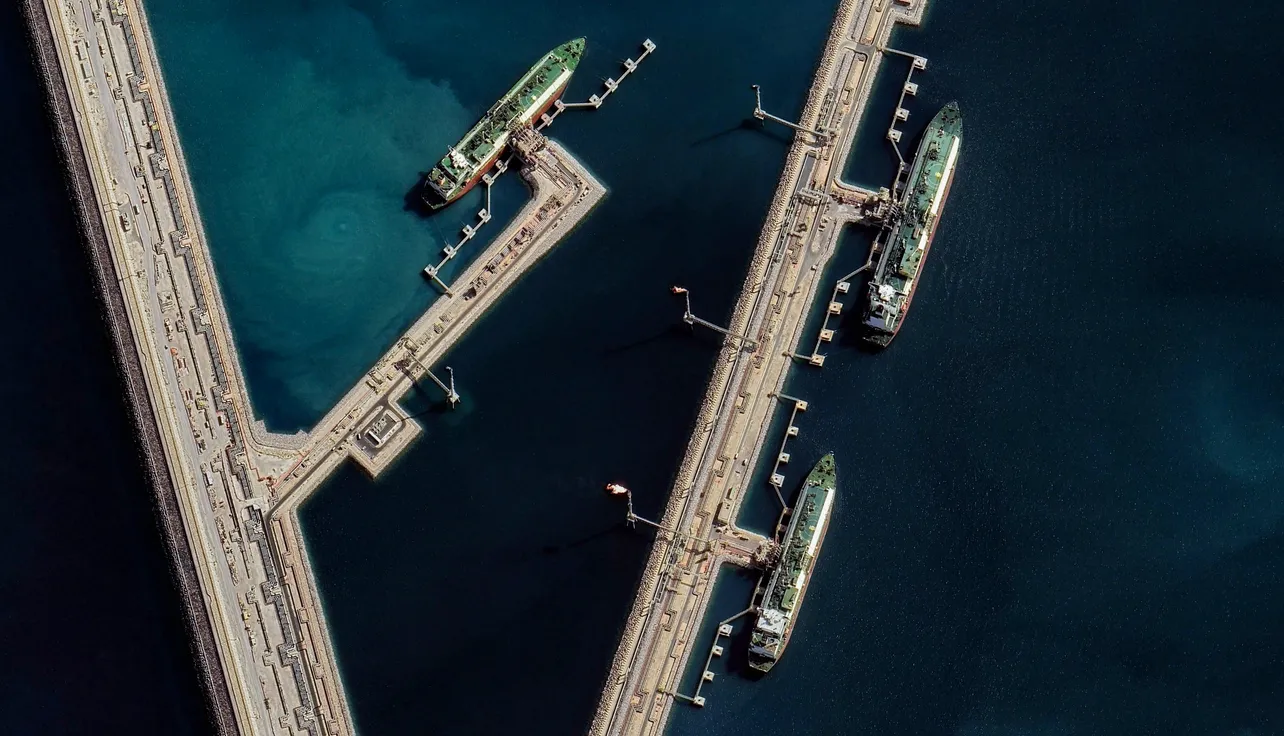
Iran’s oil exports depend heavily on Kharg Island, located roughly 25–55 kilometres off the mainland coast in the northern Persian Gulf. Since the 1960s the island has served as the country’s primary oil export hub. Pipelines from major oil fields in southwestern Iran converge at Kharg, feeding large storage facilities with a capacity of around 30 million barrels. Deep surrounding waters allow very large crude carriers to load directly at the island’s terminals.
Historically, Kharg Island has handled up to 90 percent of Iran’s crude exports and can load several supertankers simultaneously. Although sanctions and production limits have reduced export volumes in recent years, the island continues to manage the majority of Iran’s seaborne oil trade.
Qatar’s energy infrastructure is even more concentrated. Nearly all of the country’s gas production from the North Field is processed at Ras Laffan Industrial City, the largest LNG export complex in the world. Ras Laffan handles the entire chain of gas treatment, liquefaction, storage, and tanker loading. With a normal capacity of about 77 million tonnes of LNG per year, the complex plays a central role in global gas markets.
Recent events have highlighted this concentration. In March 2026, Iranian drones struck energy facilities in Ras Laffan and the nearby Mesaieed industrial area, damaging infrastructure including a power plant water tank. QatarEnergy temporarily halted LNG production and declared force majeure on exports while repairs began.
Iraq follows a similar pattern. Much of the country’s southern oil production moves toward offshore terminals near Basra, where crude is loaded onto tankers before entering shipping routes in the northern Gulf.
Across the region, these processing complexes and export terminals form the link between production fields and global energy markets.
The Maritime Corridor
Once oil and LNG are loaded onto tankers, most shipments leave the Persian Gulf through a single maritime passage: the Strait of Hormuz.
Every tanker carrying Gulf crude oil, refined products, or LNG must pass through this corridor before reaching the Gulf of Oman and the wider Indian Ocean shipping network.
Although the strait is roughly 30 to 40 kilometres wide at its narrowest point, tanker traffic is concentrated in designated shipping lanes only about three kilometres wide in each direction, separated by a buffer zone. Despite these constraints, the corridor handles some of the densest tanker traffic in the world.
Under normal conditions, approximately 20 million barrels of oil per day pass through the strait, along with large volumes of LNG and refined petroleum products.
Because exports from multiple Gulf producers rely on the same route, tankers from different countries share the same narrow corridor before dispersing toward international markets.
Bypass Routes and Alternative Infrastructure
Some producers have built alternative routes to reduce dependence on the Strait of Hormuz.
The United Arab Emirates operates the Habshan–Fujairah pipeline, which allows a portion of Abu Dhabi’s oil production to reach export terminals on the Gulf of Oman without passing through the strait.
Saudi Arabia operates a larger alternative route. The East–West pipeline transports crude from eastern production fields across the Arabian Peninsula to the Red Sea port of Yanbu, with a design capacity of up to seven million barrels per day.
Despite these alternatives, bypass routes can only divert a limited share of Gulf exports. In practice, the available infrastructure can redirect roughly 3.5 to 5.5 million barrels per day, far below the normal volumes moving through the Strait of Hormuz.
Recent incidents have also shown that alternative infrastructure can face disruptions of its own. A drone strike and fire at Fujairah temporarily affected oil loading operations outside the strait, demonstrating that energy logistics across the region remain interconnected.
The Regional Security Environment
Energy infrastructure in the Persian Gulf operates within a complex regional security environment.
The United States maintains long-standing security partnerships with several Gulf states and operates a permanent naval presence through the U.S. Fifth Fleet in Bahrain. Iran maintains influence through regional networks that include allied groups in Lebanon, Yemen, Iraq, and Syria. Israel also plays a major military role in the region and has engaged in both direct and indirect confrontation with Iran and Iranian-aligned groups.
Other major powers also have strategic interests in Gulf energy flows. China is the region’s largest energy customer, while Russia maintains diplomatic and military coordination with Iran.
These geopolitical dynamics interact with the region’s physical energy infrastructure. Many processing plants, storage terminals, and export facilities are clustered along narrow coastal areas. Because individual complexes handle large shares of national production, disruptions at a single location can affect global energy supply.
The vulnerability of this infrastructure has been demonstrated in several incidents. The 2019 strikes on Saudi Arabia’s Abqaiq and Khurais facilities temporarily removed about five percent of global oil supply. More recently, the March 2026 strikes on Ras Laffan and Mesaieed halted production at the world’s largest LNG export complex. Incidents near Kharg Island and at Fujairah also disrupted export operations in Iran and the UAE during the same period.
The Strait of Hormuz introduces another point of concentration. During the March 2026 disruption, tanker traffic through the corridor slowed significantly, with large numbers of vessels waiting on both sides of the passage. War-risk insurance premiums rose sharply, and some insurers temporarily suspended coverage for shipments moving through the Gulf.
Operational factors also influence the system. The Persian Gulf carries some of the densest tanker traffic in the world, increasing the risk of mechanical failures or navigation incidents. Extreme summer temperatures can affect equipment and port operations. Sandstorms occasionally reduce visibility along the coastline. In the northern Gulf, relatively shallow waters limit how deeply loaded large tankers can operate, concentrating the largest vessels along specific shipping routes.
Conclusion
Energy supply from the Persian Gulf depends on a system of interconnected layers. Production fields determine how much oil and gas can be extracted. Processing facilities prepare these resources for export, while terminals and pipelines connect production areas with shipping routes.
From there, most exports move through a single maritime corridor: the Strait of Hormuz. Tankers carrying oil, liquefied natural gas, and refined products pass through this narrow passage before continuing toward global markets.
Because so much of the region’s energy moves through a relatively small number of facilities and shipping routes, disruptions at any point in the system can have consequences far beyond the Gulf. Events affecting infrastructure, export terminals, or maritime traffic can quickly influence energy markets and international trade.
For this reason, developments in the Persian Gulf continue to attract global attention. The region’s energy system links production, infrastructure, and shipping into one of the most concentrated supply networks in the world.