
Free Port — Gateway Between Oceans
In 1819, the British East India Company established Singapore as a trading post.
It was designed as a free port — ships could enter, unload, and trade without paying tariffs.
Located at the tip of the Malay Peninsula, the city sits directly on the Strait of Malacca, the main sea corridor linking Asia with the Middle East, Africa, and Europe.
The strait carries roughly 35 to 40 percent of global trade by volume and about 15 million barrels of oil per day, including 80 percent of China’s oil imports.
Sitting at this crossroads, Singapore became the natural stop for refueling, maintenance, and cargo exchange.
By the late nineteenth century, it had developed into one of Asia’s most active commercial ports.
After independence in 1965, Singapore faced an economy with no natural resources and no hinterland.
The government created the Economic Development Board (EDB) to attract foreign investment and design an industrial base.
Through coordinated planning, it built Jurong Industrial Estate — the country’s first heavy-industry zone — and later Jurong Island, a reclaimed and fully integrated petrochemical complex.
From this foundation, Singapore began to expand layer by layer — trade, refining, manufacturing, and finance — forming the deliberate system that defines its modern economy.
Ports and Maritime Infrastructure
Transshipment and Container Operations
In 2024, Singapore handled 41.1 million containers, around 90 percent of which were transshipments.
Transshipment means containers are unloaded from mainline vessels — large container ships running fixed routes between major ports such as Rotterdam and Shanghai — and reloaded onto smaller feeder ships serving regional destinations.
The system allows the largest ships to remain on deep-sea routes, while smaller vessels distribute goods to secondary ports across Southeast Asia.
It lowers transport costs, increases efficiency, and anchors Singapore’s role as a redistribution hub between international and regional trade.
Re-Export — The Trading Hub Within the Port
In addition to transshipment, Singapore also runs a vast re-export trade — goods that arrive, stay briefly inside the port system, and are then sold and shipped onward.
Unlike transshipment, where containers are only moved between ships, re-exports involve goods that are brought into Singapore’s free-trade zones, where companies can store, trade, or finance them before they leave again.
These firms must be registered in Singapore, whether local businesses or foreign trading houses with offices in the city.
The goods rarely enter the domestic economy; they remain inside the port network, changing owners and destinations while staying physically in Singapore.
It is a modern version of a merchant city — a place where global products are gathered, priced, and dispatched.
In 2024, re-exports made up 57.5 percent of total merchandise exports, worth about S$ 387.9 billion.
Singapore’s total trade-to-GDP ratio stands at roughly 300 percent, meaning the value of goods and services traded through the country each year is about three times the size of its entire economy — one of the highest ratios in the world.
Much of this volume comes from energy and refined products, which pass through Singapore’s refineries and petrochemical terminals before being re-exported.
Refining and Petrochemicals
Alongside container operations, Singapore developed one of the world’s most advanced refining and petrochemical industries.
Despite having no crude oil of its own, the country has become the world’s third-largest refining hub, processing around 1.5 million barrels per day.
Crude oil is imported, refined into fuels, lubricants, and chemical feedstocks, and either exported or used domestically for industrial production.
Most of this activity takes place on Jurong Island, where refineries, petrochemical plants, and terminals are linked by pipelines, forming a single industrial network.
Feedstocks from refining supply downstream manufacturing — plastics, solvents, and coatings — integrating energy and production within one logistics system.
Bunkering and Oil Storage
Singapore is also the world’s largest bunkering port, supplying 54.9 million tonnes of marine fuel in 2024.
This involves massive storage tanks, blending and testing facilities, and a fleet of bunker barges operating across the harbor and anchorage zones.
The city’s energy infrastructure includes extensive tank farms and underground caverns, such as the Jurong Rock Caverns, which provide millions of cubic meters of storage for crude and refined products.
This storage capacity allows Singapore to act as both a fueling hub and a strategic energy reserve, serving hundreds of vessels daily and supporting the regional oil trade.
The Maritime and Port Authority (MPA) is digitizing bunker delivery processes and supporting the shift toward LNG and methanol fuels as part of a cleaner energy transition.
Marine Engineering
Supporting the port and energy sector is a large marine and offshore engineering industry.
Companies such as Keppel Offshore & Marine and Sembcorp Marine design, build, and service oil rigs, offshore platforms, and specialized vessels.
Their proximity to the port and anchorage allows repair, retrofitting, and conversion work to be completed within the same operational zone — keeping the port’s flow continuous and minimizing downtime.
Anchorage — The Open-Water Extension
Much of Singapore’s port activity happens beyond its terminals.
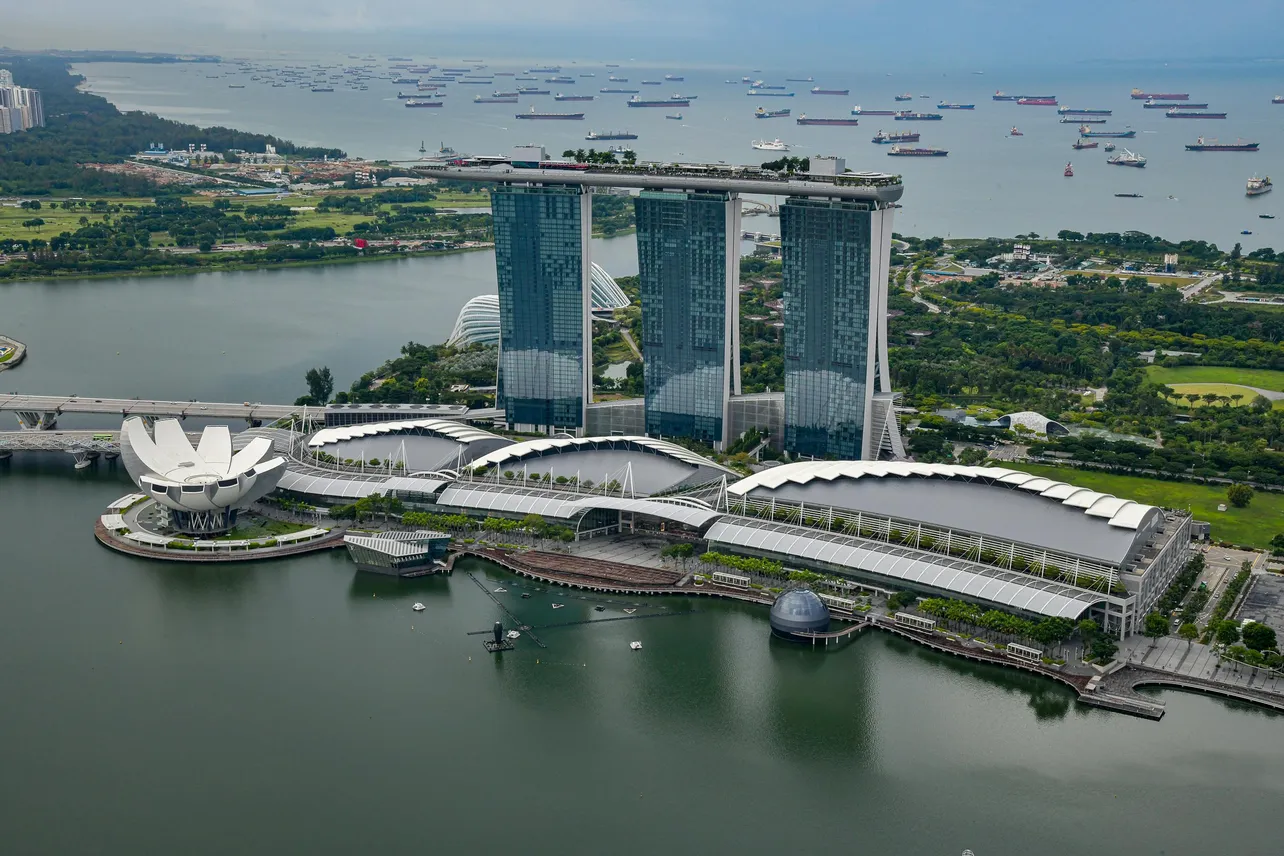
Anyone flying into the city can see hundreds of ships anchored offshore, waiting for fuel, maintenance, or new orders.
The Maritime and Port Authority of Singapore (MPA) describes these anchorages as part of the port’s infrastructure — an offshore extension where vessels can stay safely between voyages.
For shipping and trading companies, this setup is practical and efficient.
Many ships serve as floating storage, holding oil or bulk goods until prices, freight rates, or delivery schedules change.
Others simply wait for their next assignment, staying close to Asia’s main trade routes so they can sail immediately when new cargo is needed.
This design gives Singapore’s port system extra capacity and constant readiness, forming the logistical backbone that supports the flow of goods and energy through the region.
Together, container transshipment, re-export, refining, bunkering, and anchorage create a logistics ecosystem that few other ports can match.
They make Singapore not just a transit point, but a complete operational hub for global trade and energy coordination.
Manufacturing — Industry Without Resources
From refining and petrochemicals, Singapore expanded into advanced manufacturing — building a production base without natural resources.
Manufacturing contributes around 22 percent of GDP and operates as a network of specialized, export-oriented industries.
- Electronics and Semiconductors: The largest contributor to manufacturing, focused on chip assembly, packaging, and testing, with companies like TSMC, Micron, and Infineon operating major facilities.
- Pharmaceuticals and Biomedical Sciences: Production of vaccines, active ingredients, and biologics by Pfizer, GSK, and Takeda, supported by advanced logistics and cold-chain systems.
- Precision and Marine Engineering: Manufacturing of components, automation systems, and offshore equipment that directly support Singapore’s port and energy sectors.
- Chemicals and Advanced Materials: Downstream of Jurong Island’s refineries, companies produce plastics, resins, coatings, and engineered materials used worldwide.
Over the decades, Jurong Island itself evolved from heavy industrial production into a center for high-value chemicals and materials science, symbolizing Singapore’s shift from labor-intensive to high-technology industries.
Integration — The Industrial and Port System
Together, Singapore’s ports, refineries, industrial zones, and transport links function as a single connected chain.
Goods can enter, be refined or assembled, and leave again within one logistical and regulatory system.
This integration allows Singapore to capture value at every stage — from raw materials to finished exports — with almost no friction.
It is the mechanism that links the physical, industrial, and energy economies into one operational ecosystem.
Finance — Regional Control Hub
Singapore’s financial system grew out of the same principle that shaped its trade — openness balanced by structure.
In the 1970s, the government created the Asian Dollar Market, allowing international banks to borrow and lend foreign currencies, mainly U.S. dollars, from Singapore without being bound by domestic banking rules.
Transactions were booked through special accounts known as Asian Currency Units (ACUs).
Because the money circulated offshore and not in the local Singapore-dollar economy, it did not affect domestic liquidity or monetary policy.
This design attracted global banks while keeping the domestic system insulated from external volatility.
It became the foundation of Singapore’s role as a regional center for dollar funding, trade finance, and corporate treasury management.
Today, the city ranks as the third-largest foreign-exchange trading center in the world, after London and New York, according to the Bank for International Settlements.
The Monetary Authority of Singapore (MAS) reports total assets under management of S$ 5.4 trillion in 2023.
About 77 percent of these assets came from foreign investors, and 89 percent were invested abroad — showing that Singapore functions as a management and booking hub for regional and global capital.
Banks in Singapore provide payments, trade finance, and hedging for companies active across ASEAN, India, and Greater China.
The city’s real-time payment links with Thailand, Indonesia, and Malaysia allow cross-border retail and business transfers to settle instantly.
Finance in Singapore operates on the same logic as its port — moving flows efficiently, connecting systems, and reducing friction across borders.
Business Climate — Corporate and Governance Strength
On top of its dominant position in trade and finance, Singapore is equally strong as a base for business and corporate operations.
Corporate tax stands at 17 percent, with no capital-gains tax and more than 80 double-taxation agreements that prevent companies from being taxed twice on the same income.
The framework is straightforward, transparent, and supported by strong legal enforcement, giving businesses clarity and stability across borders.
Global companies including Dyson, Unilever, Google, Glencore, and numerous regional trading houses manage their Asia-Pacific operations from Singapore, coordinating logistics, trade, and finance from a single base.
The compact scale of the island allows ports, corporate districts, and industrial zones to operate as one integrated system, enabling faster decisions and lower administrative friction.
Social stability reinforces this structure.
The population includes Chinese, Malay, Indian, and expatriate communities living under a shared civic framework marked by low crime and predictable rule of law.
Together, these conditions — efficient governance, open trade, and social cohesion — make Singapore one of the most complete business ecosystems in the world.
Fintech — Infrastructure and Policy
Singapore’s next stage of development builds on its financial base.
The Monetary Authority of Singapore (MAS) promotes innovation through the Smart Financial Centre strategy, which supports fintech development in payments, blockchain, and compliance technology.
The city is home to more than 1,400 fintech firms, including startups in digital banking, trade finance, and risk analytics.
Payment systems are integrated with national digital identity and instant-transfer frameworks such as PayNow and FAST, which now link with counterparts in Thailand, Malaysia, and Indonesia.
This allows transactions between countries to clear in seconds, forming a regional digital-payment network that mirrors Singapore’s physical trade connectivity.
The government also provides regulatory clarity through sandbox licensing, allowing companies to test products under controlled conditions.
This has encouraged partnerships between global banks and fintech developers, especially in digital assets and cross-border settlements.
Singapore’s focus remains pragmatic — fintech as infrastructure, not speculation — ensuring that innovation supports the real economy rather than competing with it.
Future Outlook — Arctic Routes and New Competition
Melting ice in the Arctic is opening alternative shipping routes between Europe and Asia.
The Northern Sea Route along Russia’s coast could shorten voyages between Rotterdam and Shanghai by up to two weeks compared with the traditional Suez–Malacca corridor.
If traffic eventually shifts north, it could divert a portion of global trade away from Southeast Asia.
Singapore is preparing for this uncertainty by upgrading its maritime and digital infrastructure.
Projects such as Tuas Mega Port, automated logistics, and low-carbon fuel systems are designed to secure its role as a service and coordination hub, regardless of route changes.
Even if some long-haul traffic moves elsewhere, regional distribution, bunkering, and financial coordination will continue to depend on Singapore’s infrastructure and regulatory framework.
Conclusion
What the future brings is uncertain.
Arctic routes, digital finance, and new regional trade agreements will continue to reshape global logistics.
But the system Singapore has already built — ports, refineries, manufacturing, and finance — is extraordinary in scale and coherence.
Its total trade value equals roughly 300 percent of GDP, showing how completely the economy is built on the movement of goods, energy, and capital.
It produces little, yet coordinates enormous flows — of containers, refined fuel, electronics, and financial assets — through a single regulatory and logistical framework.
That structure makes Singapore one of the most competitive and connected economies in the world, according to the IMD World Competitiveness Ranking.
In two centuries, it has evolved from a free port into a complete system — one that connects trade, industry, and finance with a precision few nations can match.
Institutional and Data Sources
Global Economic Institutions
- IMF – World Economic Outlook / Country Reports
- World Bank – World Development Indicators
- OECD – Economic Surveys / Policy Papers
- UNCTAD – Review of Maritime Transport / Trade Statistics
- WTO – World Trade Statistical Review
- ILO / IOM – Labor and Migration Reports
National & Regional Sources (Singapore)
- MPA, MAS, IMD, SingStat – National data and official reports
Corporate and Institutional Reports
- Company Press Kits, Annual Reports, and Investor Presentations (for corporate profiles)
- Regional development banks and think tanks (ADB, EDB, etc.)
Academic & Analytical References
- AsiaScot (2023) – “The Straits of Malacca: Asia’s Artery of Trade”