
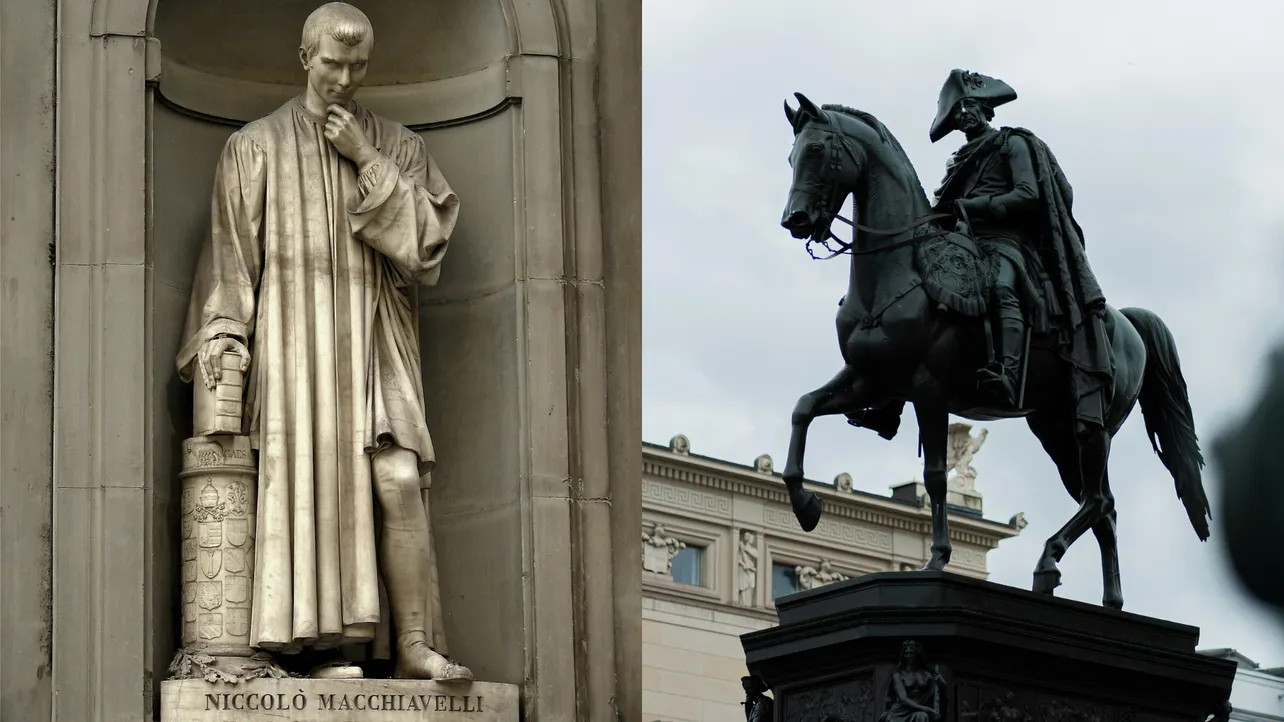
Throughout history, various leaders have organized power in different ways. This article examines four approaches to governance: Niccolò Machiavelli's analysis in The Prince and Discourses on Livy, Julius Caesar's concentration of authority, Frederick the Great's institutional reforms, and Hannibal Barca's command under civilian constraint.
Niccolò Machiavelli — Power as Survival
Niccolò Machiavelli was born in 1469 in Florence, a period of constant political turbulence. City-states across the Italian peninsula competed for dominance through shifting alliances, wars, and papal influence. Amid this instability, Machiavelli served as a diplomat and senior official in the Florentine Republic, overseeing foreign affairs and the militia. His duties included negotiating alliances with France, the Papal States, and the Holy Roman Empire, and observing foreign courts.
When the Medici family returned to power in 1512, Machiavelli was accused of conspiracy, imprisoned, and tortured. After his release, he lived in exile outside Florence, cut off from public life. It was there, in 1513, that he wrote The Prince, published posthumously in 1532.
The book marked a clear break from earlier political writing grounded in Christian morality. Machiavelli described politics as a human system governed by necessity, not virtue. A ruler, he argued, must adapt to circumstances, break promises when required, and prioritize effectiveness over moral consistency. “It is safer to be feared than loved,” he wrote.
Appearances mattered more than intentions. Morality was secondary to survival. In this framework, the ruler and the state were inseparable. If the ruler fell, the state fell with him. Preserving power was therefore not selfishness — it was political necessity.
Nevertheless, in his later work, Discourses on Livy, completed four years later in 1517, he argued that republics with strong institutions were superior to principalities. Republics were more stable and durable precisely because they did not depend on a single ruler. Institutional frameworks outlasted individuals.
Julius Caesar served as his example to illustrate these differences. In The Prince, Caesar appeared as a model of effective tactics—using generosity strategically, building military loyalty, and consolidating power through decisive action. In the Discourses, Machiavelli condemned him as the “first tyrant” who destroyed Roman liberty.
Caesar had imposed a “yoke” on Rome, he wrote, ensuring it was “never again free.” He contrasted Caesar with republican founders, viewing personal ambition as destructive to free institutions. Machiavelli recognized both realities. Caesar’s methods achieved power. They also ended the Republic.
Julius Caesar — The Politics of Ambition
More than 1,500 years before Machiavelli analyzed him, Julius Caesar demonstrated exactly this tension. Caesar was born in 100 BCE into the gens Julia, a patrician family with ancient prestige but limited wealth. He grew up in the Subura, one of Rome's densely populated lower districts, among soldiers, traders, and the urban poor.
This combination mattered. His noble lineage granted access to Rome's political system, while his lack of wealth forced him to rely on alliances, debt, and public visibility. The Roman Republic he entered was already unstable. Formal institutions existed, but power was exercised through patronage, bribery, and personal loyalty.
To rise, Caesar borrowed heavily — especially from Marcus Crassus — financing games, public works, and political favors. Debt was not a weakness. It was a mechanism of advancement.
The First Triumvirate
In 60 BCE, Caesar formed a private alliance with Crassus and Pompey the Great — later called the First Triumvirate. It was not a state institution, but a pact between three men whose strengths compensated for each other's weaknesses. The arrangement delivered results: Caesar became consul, Pompey secured land for his veterans, and Crassus gained political protection for his financial interests.
But the structure depended entirely on personal balance. When Crassus died in 53 BCE, the alliance collapsed.
Crossing the Rubicon
As Caesar's term as governor of Gaul ended, the Senate prepared to prosecute him for corruption. Under Roman law, he would lose his command upon returning to Italy. Instead, he crossed the Rubicon River with a single legion—approximately 5,000 men—in 49 BCE.
These were veterans who had fought under him for nearly a decade in Gaul, loyal to Caesar personally rather than to the Republic. It was an open act of rebellion. Civil war followed.
Caesar emerged victorious, centralized authority, reformed administration, and declared himself dictator for life. In 44 BCE, he was assassinated by senators claiming to defend the Republic. His rule produced order — but only while he lived. Once removed, the system collapsed into further civil wars.
Frederick the Great — Power as Duty
Two centuries after The Prince, Frederick II of Prussia published Anti-Machiavel — a direct rejection of Machiavelli's conclusions. Frederick wrote not as an observer, but as a ruler preparing to govern. His argument was simple: authority exists to serve the state, not the individual.
Educated in philosophy, science, and history, and influenced by Enlightenment thinkers, Frederick viewed the state as an entity separate from the ruler himself — something that should endure beyond any one person. “The king,” he wrote, “is the first servant of the state.”
Food Security — The Potato Policy
One example of Frederick's intent can be seen in his promotion of the potato as a safeguard against famine. In the 1740s and 1750s, he issued royal decrees urging farmers to cultivate the crop to secure Prussia's food base in times of war and poor harvests. At the time, potatoes were widely mistrusted and associated with poverty or superstition.
Frederick reframed the crop as a strategic resource: hardy, low-maintenance, and capable of sustaining both civilians and soldiers when grain failed. The policy did not invent the potato — it already existed — but integrated it into the agricultural system as a tool of resilience. Historians describe this as early state-driven food security: policy designed not for personal gain, but to stabilize the population. Its effects extended beyond his reign.
Administration and the State
Frederick applied the same logic to governance. Building on existing Prussian reforms, he professionalized the civil service, expanding a bureaucracy trained in economics, administration, and law. Advancement increasingly depended on education and performance rather than birth or personal favor.
Thinkers such as Pufendorf, Thomasius, and Leibniz had already articulated the idea of the state (Staat) as an entity separate from the ruler. Under Frederick, this idea became institutional practice. Officials no longer served the ruler personally — they served the state.
Public law and state finances were increasingly distinguished from the king's private interests. Authority became embedded in office, not in the person. When Frederick died in 1786, the state did not collapse. The structures he strengthened continued to function, shaped less by loyalty to a ruler than by adherence to role and rule.
Hannibal Barca — Power Without Preservation
Hannibal Barca, born in 247 BCE in Carthage, offers a different model entirely. Carthage was a commercial republic governed by a Senate of wealthy merchant families and two elected magistrates called Suffetes. Military commanders operated under civilian oversight.
The Council of 104—a judicial body—could prosecute generals who failed in their campaigns. Unlike Rome, where successful generals could leverage military loyalty into political power, Carthaginian commanders remained subordinate to civic institutions.
Hannibal's war against Rome was not a campaign for personal rule. It followed the First Punic War, which had imposed crushing reparations on Carthage and restricted its power. Rome's expansion into Iberia threatened Carthaginian survival.
Hannibal crossed the Alps not to conquer Rome for personal glory, but to force a strategic settlement. Despite repeated victories at Trebia, Lake Trasimene, and Cannae, he never marched on Rome itself. Historians still debate whether this reflected strategic calculation, supply constraints, or respect for civilian authority in Carthage that never authorized a direct assault on the city.
After Rome's final victory in 202 BCE, Hannibal returned to Carthage. In 196 BCE, he was elected Suffete and introduced financial reforms aimed at reducing corruption and repaying war debts without imposing new burdens on the population.
He reformed tax collection to eliminate embezzlement by officials, restructured debt repayment schedules, and worked to restore Carthage's finances. These reforms strengthened Carthaginian institutions but threatened powerful families who had benefited from the previous system.
When Rome demanded his extradition in 195 BCE, Hannibal went into exile rather than resist. Carthage continued to function. His legacy was not empire, but resistance—and a demonstration that military commanders could operate under institutional constraint without seeking personal rule.
What These Models Reveal
Machiavelli argued that without the ruler, the state collapses — therefore the ruler must do whatever is necessary to survive. Caesar proved how far that logic could go. Frederick showed a different path: strengthening institutions so authority survives beyond the individual. Hannibal demonstrated that power does not always seek preservation — sometimes it exists only to defend something larger.
None of these figures were perfect. Each operated under pressure, constraint, and conflict. But their outcomes differed — not because of intention alone, but because of how power was structured.
Modern organizations face similar choices: concentrate authority in founders and executives, or embed it in institutional frameworks. Corporate succession, political transitions, and military command structures still reflect these competing models. The patterns Machiavelli observed—personal rule producing fragility, institutional frameworks enabling continuity—appear across contexts separated by centuries. That difference remains relevant.