
For decades, the Arctic was treated as a blank space on the map — a region defined by ice, scientific missions, and isolated settlements. Commercial activity was minimal, and for most governments and industries the High North played a marginal role.
That position is changing. As sea ice retreats and technology improves, the Arctic has become a zone of trade, energy development, and long-term strategic planning. Governments are drafting Arctic policies, shipping firms are studying northern routes, and energy companies are expanding projects across coastal regions. Each development points to the same trend: the Arctic is moving from isolation to integration.
This article outlines the economic transformation now underway — how access is changing, which resources matter, and how states, particularly Russia and China, are building the infrastructure that supports activity in the High North.
What Is Changing in the Arctic
The Arctic is warming roughly four times faster than the global average. As a result, the ice melts earlier in spring and refreezes later in autumn, widening the seasonal window in which ships, survey teams, and engineers can operate.
In the 1980s, the region offered about one month of navigable conditions for commercial vessels. Today, the window lasts three to four months, and scientific models suggest it could reach six to seven months by the 2030s.
This extended access affects the Arctic’s three main sea corridors:
- Northern Sea Route — along Russia’s Arctic coast to the Bering Strait
- Northwest Passage — through Canada’s Arctic archipelago
- Transpolar Sea Route — across the central Arctic Ocean, potentially viable later this century
These routes have existed for centuries, but longer open-water periods make them more usable for modern logistics. The same retreat of ice also exposes land and seabed previously inaccessible to geological surveys or engineering work. Areas once unreachable now allow longer drilling seasons, equipment installation, and exploration of shelves containing hydrocarbons and minerals.
The shift is therefore broader than shipping. It is a change in access — to water, to ground, and to resources — and access is reshaping economic interest across the region.
Resources — Why the Arctic Matters Economically
The Arctic contains some of the world’s largest undeveloped reserves of natural gas, oil, and critical minerals. A 2008 U.S. Geological Survey assessment—the most comprehensive to date—Estimates suggest that the Arctic contains about 13% of the world’s undiscovered conventional oil and 30% of undiscovered conventional natural gas, most of which is offshore. Key areas include Russia’s Yamal and Gydan Peninsulas, Norway’s Barents Sea, Alaska’s North Slope, and Canada’s Mackenzie Delta.
Mineral access is also increasing. Greenland holds significant deposits of rare earth elements, zinc, nickel, and other strategic minerals essential for batteries, advanced electronics, renewable energy systems, and defense technologies. These resources are the reason Greenland appears in U.S. and European supply-chain strategies.
As in temperate regions, the resource potential in the Arctic only gains value when the necessary infrastructure is in place. This includes ports, pipelines, storage facilities, and ice-capable ships, all of which are essential before production can increase. Consequently, geological interest directly influences investment in northern infrastructure.
Russia — Building an Integrated Arctic Transport and Energy System
Russia leads the industrial build-out of the Arctic, and its efforts center on the Northern Sea Route (NSR).
The corridor extends from Murmansk near Norway and Finland to the Bering Strait between Siberia and Alaska and is the only Arctic route currently supported by a complete transport chain.
Russia is building a connected system of ports, LNG terminals, repair facilities, and supply points designed to keep vessels moving through ice-affected waters. This network forms the operating backbone of the NSR and the foundation of Russia’s broader Arctic strategy.
Navigation in the Arctic requires a specialized, coordinated fleet:
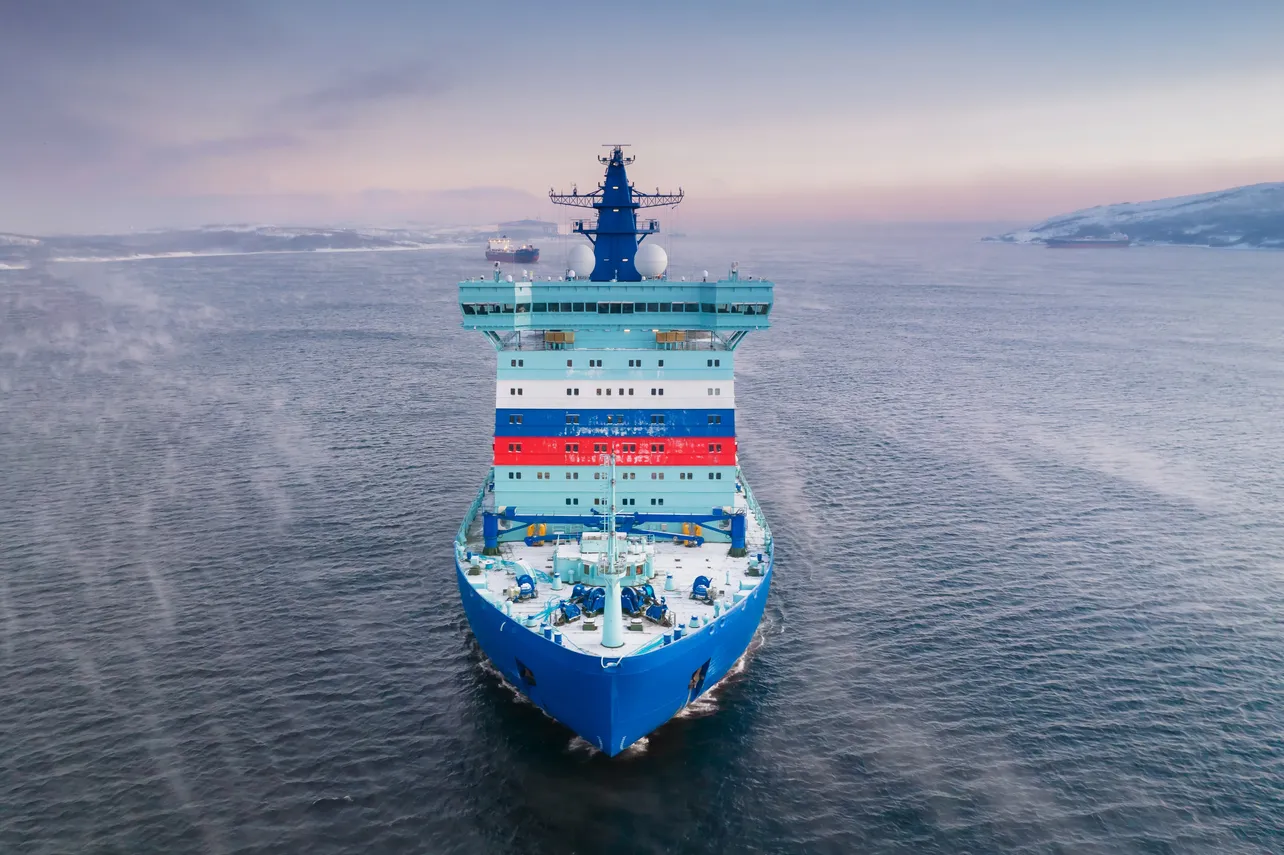
- Icebreakers- open channels through sea ice. Russia operates the world’s largest fleet nuclear-powered fleet.
- Ice-class carriers- reinforced tankers and cargo ships — transport LNG, oil, minerals, and supplies between Arctic fields and coastal terminals.
- Conventional deep-sea vessels handle cargo once it reaches ice-free waters.
Ice-class vessels are designed for short trips in ice-covered waters and tend to be slow and fuel-consuming in open water. Therefore, it is crucial to transfer goods to conventional deep-sea ships, which operate more efficiently in open seas but are less suitable for Arctic waters. Transshipment hubs serve as the key link, connecting Arctic transport with the global shipping network.
Recently, a deep-sea ship successfully completed the entire route without transshipment, but these are still considered trials that showcase potential outcomes. In 2025, the Istanbul Bridge, a standard deep-sea container ship and not ice-strengthened, made a 20-day crossing from Qingdao to the UK via the Northern Sea Route during peak summer. This demonstrated that non-specialized ships can navigate the corridor under optimal conditions, although such voyages remain rare and are not yet part of a scalable commercial service.
Transshipment Hubs
Transshipment in the Arctic is different from that at typical hubs like Singapore. In global logistics, transshipment generally involves moving containers between deep-sea vessels and regional feeders or other large ships. In the Arctic, it specifically refers to transferring cargo from ice-capable ships to deep-sea vessels.
Transshipment hubs bridge this gap. Cargo is offloaded from ice-class vessels at the edge of the Arctic and reloaded onto standard ocean-going ships for the journey toward Europe or Asia.
Russia operates two hubs:
- Murmansk — Located on Russia’s northwest coast, near Norway and Finland.
Ice-free year-round, making it the main European gateway for Arctic cargo. - Kamchatka — Located on Russia’s Pacific coast, close to the Bering Strait between Russia and Alaska.
Serves as the handover point for cargo moving toward Asia-Pacific markets.
Both are expanding with LNG loading arms, storage, and repair capacity. They are also conducting pilot container activity with Chinese partners — a signal that Russia aims to extend transshipment beyond energy cargo to general freight.
Together, these terminals form the operational structure that allows Arctic traffic to shift between ice-class vessels and open-sea carriers.
What Is Already Moving
Arctic transport is no longer theoretical. The Northern Sea Route is already moving cargo at a commercial scale. In 2025, Russia exported about 18.8 million tons of LNG, split almost evenly between Europe and Asia. The Yamal LNG project alone ships roughly 21 million tons per year, equal to about 5 percent of global LNG trade.
Murmansk, the main western hub, now handles around 58 million tons of cargo annually, making it the largest logistics center in the Russian Arctic. These volumes remain small in global terms, but they confirm that the northern corridor functions reliably during the open-water season.
Russia expects this activity to grow sharply. Official projections for 2030 estimate 100–150 million tons of total cargo along the Northern Sea Route, supported by new LNG capacity at both ends of the corridor — roughly 20 Mtpa in Murmansk and a similar level in Kamchatka.
The entire system depends on Russia’s icebreaking capability. The country operates the world’s only nuclear-powered fleet, with seven active vessels today and planning to expand to 15–17 by 2030. These ships extend the navigable season and keep traffic moving at the edges of the ice and can run for long operating hours due to their nuclear power station.
China — The Polar Silk Road Developement
China describes itself as a “near-Arctic state,” and its 2018 Arctic Policy incorporates the region into the Belt and Road Initiative as the Polar Silk Road. The policy sets out five long-term goals, including scientific exploration and understanding of the Arctic, as well as other broad objectives.
Within this broader framework, China identifies three long-term practical objectives for its economic and logistical activity in the High North:
- Developing Arctic shipping lanes
- Supporting Chinese companies in infrastructure and energy
- Deepening cooperation on research, navigation, and governance.
To realize the planned policy, China mobilizes and coordinates with a network of state-linked enterprises and policy banks to advance regional infrastructure development.
- COSCO Shipping Group
COSCO is China's national carrier and a leading operator in the arctic routes. It is investing in ice-class cargo and LNG vessels built for navigation on the Northern Sea Route — ships reinforced for ice that still rely on Russian icebreakers in heavy conditions. - CNPC and CNOOC
China’s national energy companies hold equity in Yamal LNG and Arctic LNG-2, giving them long-term access to production and anchoring China into Arctic energy supply chains. - Silk Road Fund & China Development Bank
Provide loans, guarantees, and financial packages for Arctic terminals, port upgrades, and logistics hubs. Their support lowers commercial risk and enables investment at northern scale. - China Merchants Group
Works on port construction, ship-repair capabilities, and the operation of terminals that handle transfers between ice-class and deep-sea vessels.
Combined, these actors create a fully linked system: COSCO provides the ships; CNPC and CNOOC secure the cargo; policy banks finance the infrastructure; and China Merchants builds and maintains it.
Coordination with Russia
China’s Arctic strategy is implemented primarily through cooperation with Russia.
In 2025, both governments signed a framework agreement aligning the Polar Silk Road with the NSR. The agreement covers shipbuilding cooperation, satellite-navigation integration (linking GLONASS and BeiDou), and the development of logistics hubs intended to operate reliably as the navigable season lengthens.
Chinese research institutions — including the Shanghai Institutes for International Studies and the Polar Research Institute of China — describe this partnership as structural: Russia provides Arctic infrastructure and experience, while China contributes capital, shipbuilding capacity, and long-term commercial demand.
Feasibility and Industry Perspective
Despite visible progress, large-scale commercial use remains limited. Western insurers still classify most Arctic voyages as high-risk, leading to premiums up to three times higher than traditional Asia–Europe routes via the Suez Canal.
The higher pricing reflects concrete operational factors. Extreme cold increases the likelihood of technical failures in engines, pumps, and safety systems. There are few deepwater ports or repair yards along the route, so any serious incident can require long-distance towing or specialised assistance. Search-and-rescue capacity is limited, and response times are longer than on established shipping lanes. These elements raise potential loss costs, and insurers price that risk into the premium.
Major carriers such as MSC and Maersk have stated that Arctic operations are not yet economically viable, citing weather uncertainty, limited infrastructure, and environmental risk. For now, they prefer established southern routes where conditions, repair options, and insurance frameworks are more predictable.
Chinese analysts acknowledge the risks and costs for Arctic trade but mention that the route is a strategic rather than purely commercial investment. Studies by the Shanghai Institutes for International Studies and the Polar Research Institute of China note that insurance and operational costs are likely to fall as infrastructure expands and as transshipment hubs shorten exposure to ice zones.
Lloyd’s Register estimates that routing part of the voyage through established transshipment terminals could reduce insurance premiums by 20–40 percent, bringing total costs closer to standard levels.
Other Institutions argue that traffic will remain under 2 percent of total Asia–Europe trade through 2050, reflecting the route’s niche role rather than a mainstream shift in global shipping.
The Western Arctic — Limited Economic Expansion
Development in the Western Arctic advances at a slower pace because of geographic factors, ice conditions, and regulatory restrictions.
Canada Maintains selective development along the Northwest Passage, which remains shallow, unpredictable, and blocked by multiyear ice since the route is not melting as much. Infrastructure is limited, and operations focus on environmental management and scientific research.
The United States (Alaska) holds large onshore reserves but lacks deepwater Arctic port capacity. Planned ports are still in early development, keeping commercial activity small.
Norway runs advanced Barents Sea projects but emphasizes strict environmental rules and controlled extraction, prioritizing safety and ecosystem protection over network-style expansion.
What the Arctic Is Becoming
A clear pattern has emerged across the High North:
- The navigable season is lengthening by weeks every decade.
- Previously inaccessible hydrocarbon and mineral reserves are entering the realm of commercial possibility.
- Infrastructure — led by Russia and financed in large part by China — is being built at scale along the northern coast.
By 2025, it appears that Arctic routes will not surpass the volume of the Suez Canal in the near future. But there is intentional development of a strong, seasonal trade and energy corridor that already transports large volumes of LNG and critical minerals annually.
What Comes Next
This article has focused on the economic and logistical transformation of the Arctic — navigation, resources, ports, icebreakers, and transshipment hubs.
Part Two will examine the parallel geopolitical and military layer: new bases and dual-use infrastructure, territorial claims, NATO’s northern expansion, and the strategic postures of Russia, China, and the United States in a region that is no longer remote.
Together, the two pieces will map the Arctic’s emerging role — economically and strategically — for the decades ahead.