
Artificial intelligence has revived debates about productivity, prices, and economic structure. The discussion centers on how much efficiency AI adds, whether those gains lower production costs, and how far they might reshape the relationship between work, income, and access to goods.
Views vary from modest improvements to industry-wide changes, with some suggesting that production might become so inexpensive that traditional employment becomes optional. This article explores these viewpoints, the connection between productivity and prices, the structural limits faced by technological advancements, and the implications when scarcity changes rather than vanishes.
What Productivity Means in Practice
Productivity increases when the same output is produced with fewer inputs — typically labor, time, coordination, or capital.
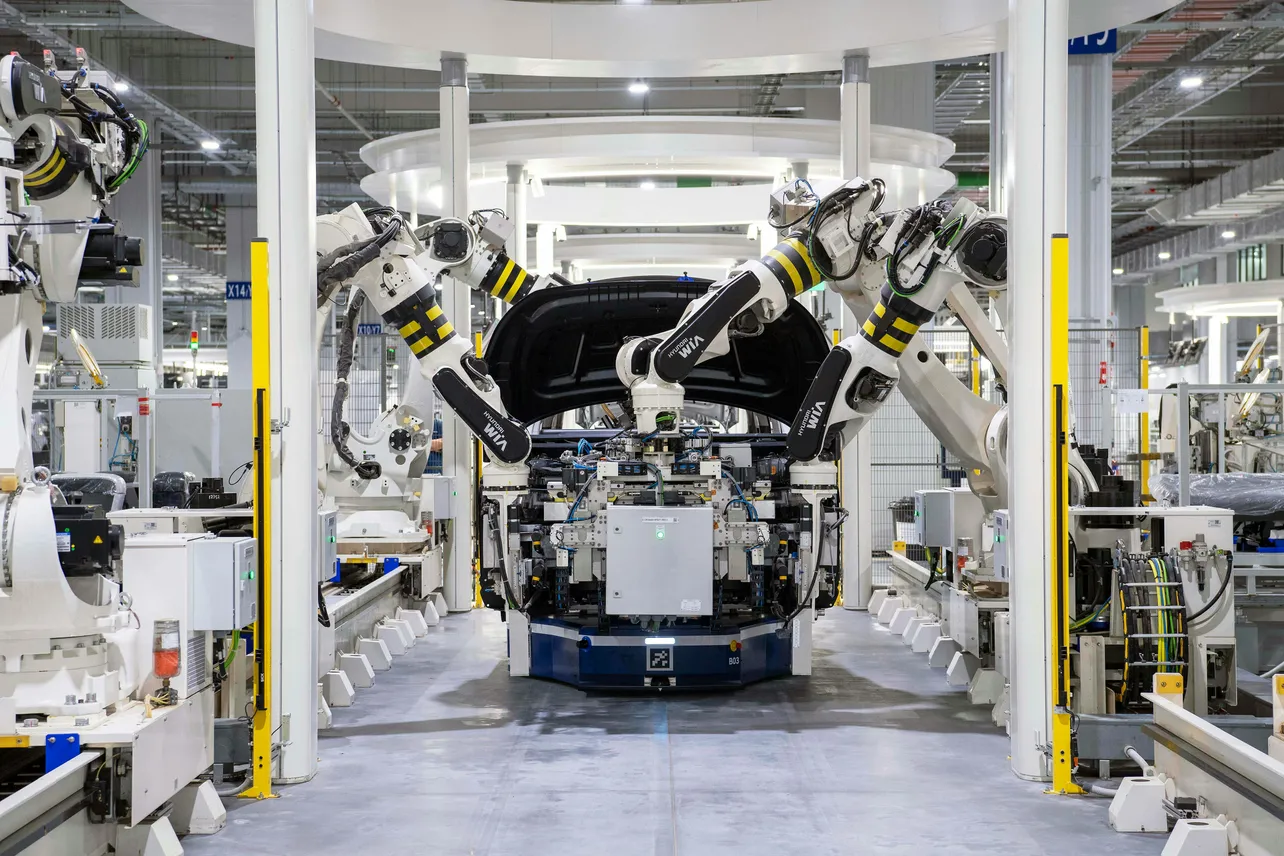
AI reduces the amount of human attention required for routine work. In manufacturing and logistics, software now handles scheduling, routing, and inventory management in real time. Many processes that once required frequent manual checks now run with automated monitoring, freeing people to focus on exceptions and decisions.
A warehouse using automated picking and routing can process more shipments per shift than a manual operation. A customer support center can handle higher volumes without expanding staff at the same pace.
At this level, the economic effect is straightforward. Output rises faster than inputs. Unit production costs fall. Firms can produce more with fewer resources.
This is the shared starting point in most discussions of AI and productivity.
How Much Productivity AI Adds — and Where
There is no single estimate of how much productivity artificial intelligence will add. Economists emphasize different constraints depending on where they believe gains stall.
Daron Acemoglu, whose work focuses on technology and labor, argues that AI is more likely to raise productivity in specific tasks than transform entire economies. Past technologies that promised sweeping efficiency gains often delivered modest results once adoption costs, organizational friction, and institutional limits were considered.
David Autor takes a related view. His research shows that technology reshapes work rather than simply replacing it. Automating narrow functions can improve efficiency locally, but system-wide gains depend on whether jobs and workflows are reorganized around those tools.
Institutions such as the International Monetary Fund and the OECD adopt a conditional position. Their assessments suggest AI could raise productivity over time, but only with broad adoption and complementary investment — including skills, infrastructure, and organizational redesign. In this view, gains are possible, but uneven and gradual.
Some technology leaders offer a broader interpretation. Elon Musk represents the most expansive view of AI-driven productivity.
In this perspective, artificial intelligence, robotics, and abundant energy push productivity far beyond previous industrial shifts. If machines handle nearly all production, costs collapse, and prices follow. Work becomes less central to income, potentially reducing the centrality of money in meeting basic needs.
This is not a short-term projection but an end-state vision. It assumes productivity reaches levels at which scarcity no longer functions as a binding constraint. The assumptions are demanding — requiring energy abundance, automated construction, scalable healthcare and education, and reduced location-based scarcity. The vision is internally coherent, but contingent on sustained technical success, political coordination, and institutional stability.
Sam Altman, on the other side, expects large productivity gains as well, but emphasizes disruption — arguing that income may temporarily decouple from work as labor markets adjust.
From Production Cost to Consumer Price
As many economists and tech leaders illustrate, AI is likely to improve productivity in one way or another. But that does not guarantee an overall price reduction.
Lower production costs make goods cheaper to produce, but they do not necessarily lead to lower consumer prices. Firms set prices based on what customers are willing to pay, shaped by brand, perceived value, positioning, supply and demand, and available alternatives. When costs fall, firms either lower prices or keep them unchanged and capture the savings as profit. As a result, cost reductions may translate into lower prices in competitive markets, or into higher profits where pricing power exists.
Smartphones illustrate this clearly. Manufacturing costs have fallen dramatically as production became standardized and automated. Yet premium devices remain expensive because pricing reflects brand, ecosystem, and design—not production efficiency alone. A device costing a few hundred dollars to produce can sell for far more because the market supports that price.
The same pattern appears elsewhere. Cars are produced with fewer labor hours than decades ago, but prices have not collapsed. Airline operations are highly optimized, yet ticket prices fluctuate based on timing and demand. Software can be copied at near-zero cost, but access is sold through subscriptions and tiers. Productivity lowers the cost floor. It does not determine where prices settle.
Some other sectors resist productivity-driven cost declines by their nature.
Housing is one such case. Automation and modular construction can reduce build costs and increase the number of housing units that can be delivered. But housing prices are not determined by production cost alone. In dense urban markets, land value often accounts for the majority of a property’s price — in some cities making up 50 to 80 percent of total value. City centers have fixed geography, and lower construction costs do not remove location-driven scarcity.
Healthcare faces a different constraint. Artificial intelligence and automation can reduce costs and improve efficiency in diagnostics, administration, and monitoring. However, medical care is delivered on a case-by-case basis, and prices are shaped less by direct market competition than by insurance systems, regulation, and institutional incentives. As a result, productivity gains often improve capacity or quality, but do not reliably translate into lower household costs.
Some goods remain scarce because they are constrained by physics and geopolitics rather than production efficiency. Gold cannot be mass-produced. Industrial materials such as silver, nickel, and rare earth elements are limited by geology and concentrated supply chains. While extraction and processing can become more efficient, prices are set on global markets, shaped by supply and demand, trade policy, and geopolitical risk. As a result, productivity improvements affect output and cost structures, but do not eliminate scarcity or reliably push prices lower.
Energy represents a related constraint. AI-driven productivity depends on computing power, and computing power depends on electricity. While energy generation can scale, it requires capital-intensive infrastructure and long lead times, and prices are shaped by regulation, fuel markets, and geopolitics. As a result, energy availability and cost act as a limiting factor for how quickly AI-driven productivity gains can expand.
Although there are challenges, some interpretations propose that productivity gains could be so significant that production costs and prices might fall to the point where work and income become unnecessary for affording basic goods.
Extreme Productivity, Distribution, and Demand
The concept that productivity could reduce the cost of fundamental goods to nearly zero is often seen as a theoretical ideal.
In this vision, automation, robotics, and energy enable essential products to be produced at very low marginal costs. As a result, minimal human labor is needed, making work unnecessary to earn an income to meet basic needs. This connection explains why unconditional income and the diminishing importance of retirement are frequently associated with this idea.
Even if technological challenges are overcome, the transition toward such a system raises questions about distribution and behavior rather than production alone.
One challenge is taxation. To fund unconditional income or support retirement systems in a highly automated economy, states would need to tax AI-generated wealth at the corporate level. However, research by economists such as Gabriel Zucman and by institutions including the OECD and IMF shows that highly digitalized companies can relocate profits, data, and intellectual property across borders with relative ease. Aggressive attempts to fund universal programs through concentrated technology taxes, therefore, risk weakening the link between where value is created and where it can be redistributed.
A second consideration is behavioral. Research in behavioral economics, often described as the hedonic treadmill (Brickman and Campbell), shows that people adapt quickly to higher levels of material comfort. As productivity lowers prices, cheaper goods become the new baseline rather than reducing demand. This matters for unconditional income: even if income guarantees access to today’s basics, expectations tend to rise alongside living standards, limiting its long-term sufficiency.
At the same time, economists such as Fred Hirsch have shown that many goods function as positional goods — valued because they are scarce relative to others. Desirable locations, status, exclusive services, and unique human output cannot be scaled by automation. As manufactured goods become cheaper, competition shifts toward these scarce categories. Income therefore remains relevant for allocation, even in highly productive systems, because scarcity does not disappear — it relocates.
A more incremental interpretation focuses on transition rather than end state. Sam Altman has argued that productivity gains from AI may arrive faster than labor markets can adjust, creating periods where work, wages, and output become misaligned. In this view, unconditional income is not a signal that scarcity has disappeared, but a stabilizing mechanism to manage disruption while new forms of work and income emerge.
Altman’s approach treats income support as a buffer rather than a replacement for the existing economic system. Work remains relevant, prices continue to allocate scarce goods, and productivity improves living standards without removing the need for income altogether.
Conclusion
Artificial intelligence is likely to raise productivity. On that, there is broad agreement. Where views diverge is in how far those gains extend — into prices, labor, income, and scarcity.
Productivity lowers production costs, but prices are shaped by demand, market power, regulation, and constraints that technology does not automatically remove. Some goods become cheaper and more accessible; others remain scarce due to geography, geopolitics, or relative value. As material baselines rise, expectations adjust accordingly.
More expansive interpretations treat productivity as sufficient to dissolve the link between work and income. More incremental views focus on adjustment — how institutions and labor markets adapt as technology advances. In both cases, outcomes depend less on productivity alone than on how gains are distributed and how scarcity continues to operate.
AI may change what is abundant and what is scarce. It does not eliminate the distinction.