
From Dagestan to the National Program
Artur Beterbiev was born in Dagestan in 1985 and started boxing early. He trained inside Russia’s national sports schools, where fighters develop through repetition and structure. Sessions emphasize clean form, discipline, and technical consistency.
Between 2006 and 2010, Beterbiev won European and World Championship titles and represented Russia at two Olympic Games. His amateur record placed him among the top light-heavyweights of his generation and set the stage for his move into the professional ranks.
Montreal — The Ramsay System
After the 2012 Olympics, Beterbiev moved to Montreal to begin his professional career with coach Marc Ramsay.
In a 2024 interview with BoxingScene, Ramsay mentioned that Beterbiev had been “very well educated, technically” by the Russian amateur system and “already had power.” Ramsay’s task was not a technical overhaul, but rather to work on “a couple of little details” to adapt the power and technique to the pro style and last the full twelve rounds instead of relying on early knockouts.
Ramsay’s focus was rhythm and energy control — slowing the pace without losing pressure. Training centered on repetition — the same movements performed over and over so that they would last even when fatigue set in.
Ramsay’s approach fit Beterbiev perfectly. The system was built on repetition and rhythm — the same work done over and over until it stayed stable under pressure and could last the full 12 rounds. The training focused on simple repetition and execution of the same technique again and again — a process Beterbiev himself has emphasized as requiring the same work every day with the same focus.
Fighting Style
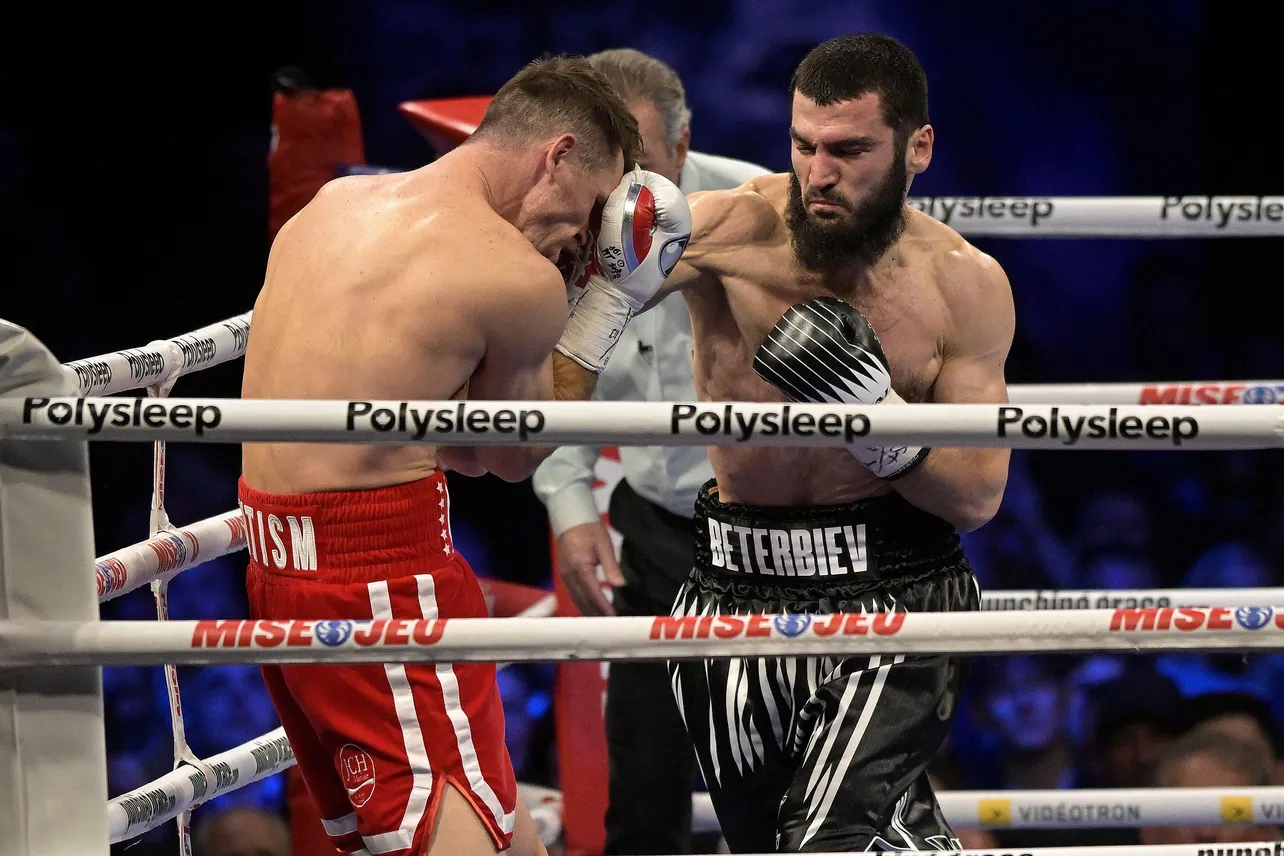
Beterbiev’s style is built on control. He fights behind a high guard and applies controlled and steady forward pressure. Each step is short and measured, keeping him balanced and close enough to strike. The goal is not to surprise the opponent, but to stay in range and apply steady pressure without giving space back.
Every punch comes from a solid stance, not from within movement. His feet stay planted long enough for the hips to turn fully, and the power transfers straight through the target. The shots are short, precise, and heavy — not explosive. The force comes from structure, not from speed. Because his balance never breaks, he delivers the same power from the first to the last round.
There is no wasted motion. The jab measures distance and keeps rhythm. The guard stays high, and the feet adjust only as needed — small steps, steady position. Everything stays tight, composed, and efficient. What looks simple from the outside is control in its purest form — movement reduced to what matters.
Power That Doesn’t Fade
Almost every one of Beterbiev’s professional wins has ended by knockout. His fights follow the same pattern: calm control in the early rounds, rising pressure through the middle, and a clean finish once balance breaks. The power he generates is heavy rather than explosive — a result of structure, not aggression. Opponents describe it as a force that doesn’t fade. The pace feels steady, but the impact adds up with every exchange.
The statistics confirm it. Each of his world-title victories ended inside the distance. There are no wild swings or rushed finishes — just consistent pressure until the opponent can no longer hold position. It is efficiency turned into power.
Repetition as Method
Training in Ramsay’s gym follows the same rhythm. Pad rounds focus on distance and accuracy. Bag work tests endurance while maintaining shape. Strength sessions use basic lifts performed at steady pace. Nothing changes except intensity. Each drill is repeated until it can be done under fatigue with the same control as at the start.
Beterbiev rarely talks about motivation. He speaks about work, rest, and execution. Every camp follows the same schedule because repetition removes uncertainty. Fatigue is treated like any other technical factor — to be managed, not feared.
At nearly forty, his habits have not changed. The base remains solid, the pressure steady, and the results the same.
Endurance Through Repetition
Beterbiev’s style is his own — a compact, forward-moving system with a high guard and steady pressure, where every punch comes from a solid base — precise, short, and heavy rather than explosive. Not every fighter moves like that. Some rely on speed, others on counterpunching or volume. But the discipline behind his approach — repeating the same mechanics until they stay stable across every round — is universal.
His record shows that endurance is not only about conditioning. It comes from doing the same motion until it holds under fatigue. Whether a fighter moves forward like Beterbiev or boxes at distance like Bivol, the principle is identical: technique must last as long as the fight does.
Sources
- BoxingScene (2024) —https://www.boxingscene.com/articles/artur-beterbievs-trainer-reveals-secrets-his-fighter-staying-young
- Reuters (2024) — Coverage of world-title bouts and knockout statistics.
- The Ring Magazine (2023–2024) — Fighter profile, amateur titles, Olympic participation.
- AIBA / IBA Records — European and World Championship results (2006, 2009, 2010).
- ESPN / Sky Sports (2022–2024) — Interviews with Artur Beterbiev on discipline and daily training consistency.
- Russian Ministry of Sport — National sports-school structure and methodology.
- BoxRec — Verified professional record and fight data.