
For decades, international football has been governed by non-profit organizations, including FIFA, the continental confederations and national football associations.
FIFA has now proposed the creation of FIFA Forward Enterprise, a separate commercial company that would manage its commercial activities while allowing outside investors to acquire a minority stake. The proposal has prompted UEFA to announce a boycott of FIFA competitions if it proceeds.
This article explains FIFA's proposal, how international football is organized, and how the proposal could influence the future commercial structure of international football, including its potential implications for national football associations.
How Is International Football Organized?
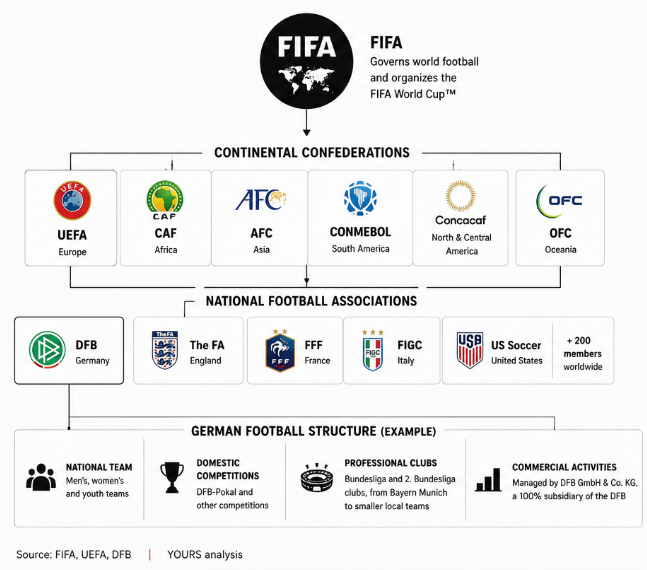
International football is organized across three levels. At the highest level is FIFA, which oversees international football and organizes competitions such as the FIFA World Cup. Beneath FIFA are the six continental confederations, including UEFA in Europe, CAF in Africa, AFC in Asia, CONMEBOL in South America, Concacaf in North and Central America and the Caribbean, and OFC in Oceania. These organizations are responsible for football within their respective regions and organize continental competitions such as the UEFA European Championship, the AFC Asian Cup and the Copa América.
Each continental confederation is made up of national football associations. Every country has its own association, such as the German Football Association (DFB), The Football Association (FA) in England or the United States Soccer Federation. These associations organize football within their own countries, manage the national teams and oversee domestic competitions such as national cup tournaments.
Professional clubs, such as Real Madrid, Bayern Munich or Manchester United, operate within this system but remain separate from the national associations. They compete in domestic leagues and international club competitions throughout the season, while players are periodically released to represent their national teams in competitions organized by FIFA or the continental confederations.
How Does FIFA Operate?
Unlike professional clubs such as Liverpool or PSG, FIFA is not owned by shareholders and does not operate as a commercial company. Instead, it earns money by organizing international competitions, particularly the FIFA World Cup, and selling the commercial rights associated with these tournaments.
Television broadcasters purchase the rights to show World Cup matches to audiences around the world. Companies pay to become official FIFA partners and sponsors, giving them the right to use FIFA branding and advertise during FIFA competitions. Additional revenue is generated through ticket sales, hospitality packages for corporate guests, licensing agreements for official merchandise and other commercial rights linked to FIFA tournaments.
Rather than distributing these revenues to shareholders, FIFA uses the income to organize competitions, operate the organization and provide funding to its 211 member associations and football development programmes.
This model is not unique to football. The International Olympic Committee also operates as a non-profit governing body, generating revenue from the commercial rights of the Olympic Games before redistributing much of that income across the Olympic Movement.
Other sports operate differently. Formula One's commercial rights are owned by a private company rather than a non-profit governing body. Like other commercial businesses, its objective is to increase value for shareholders. Revenue from broadcasting rights, sponsorships, hospitality and other commercial activities is therefore used not only to operate and develop the business, but also to generate returns for investors.
What Is FIFA Proposing
FIFA is now proposing to reorganize its commercial activities through the creation of FIFA Forward Enterprise (FFE), a separate company that would manage broadcasting rights, sponsorships, licensing, hospitality and the commercial delivery of FIFA competitions.
Under the proposal, FIFA would remain the majority owner while selling a minority, non-controlling stake, reported at up to around 20 per cent, to outside investors. The proposal values the new company at approximately US$20 billion, with the aim of raising up to US$4.2 billion. FIFA would continue to govern international football and retain exclusive authority over competitions, the match calendar and all sporting and regulatory decisions.
According to FIFA, this structure would allow the organization to unlock additional capital while maintaining full control over international football. The funds raised through the sale of a minority stake would be used to increase investment in football development, while the new company would provide a more specialized structure for managing FIFA's commercial and event operations. FIFA has also proposed significantly higher development funding for its 211 member associations over future funding cycles as part of the overall package.
The proposal has, however, been met with strong opposition from UEFA. Following an emergency meeting involving its 55 national associations, UEFA announced that it would boycott FIFA competitions, including the FIFA World Cup, if FIFA proceeds with the proposal. UEFA has criticized both the consultation process and the introduction of private investment into FIFA's commercial activities. It argues that the World Cup should remain under the control of football's institutions rather than becoming part of an investment structure and has called on FIFA to abandon the proposal.
From a business perspective, outside investors generally invest with the expectation that a company will increase in value over time. In the sports industry, this often includes expanding media rights, attracting new commercial partners, growing international audiences, developing digital products, improving commercial operations and identifying additional sources of revenue.
Applied to FIFA, this does not necessarily mean fundamental changes to football itself. From an investor's perspective, however, commercial growth could come through increasing the value of existing competitions, developing additional tournaments, expanding into new markets, strengthening digital platforms or creating new commercial opportunities. Whether such strategies are ultimately pursued would remain a decision for FIFA, which under the proposal would continue to retain control over football governance and sporting decisions.
Implications for National Football Associations
The concept of separating commercial activities from football governance is not unique to FIFA. Several national football associations already operate through separate commercial entities. The German Football Association (DFB), for example, manages many of its commercial activities through DFB GmbH & Co. KG, while the governing body itself remains a non-profit association. The difference is that these commercial entities are generally owned entirely by the association rather than by outside investors.
If FIFA's model proves successful, it could provide a blueprint for other national football associations considering a similar approach. The key difference would be the introduction of outside investors into the commercial side of national football while the associations themselves would continue to oversee the sport.
For smaller associations this could, in theory, provide access to capital that would otherwise be difficult to obtain. A national team that attracts unusual international attention, for example through a successful World Cup qualification or a strong tournament performance, might seek investment to expand sponsorship, merchandise, digital media or the international promotion of the national team brand.
If adopted more widely, such a model could gradually increase the commercialization of national football. While sporting decisions could remain with the associations themselves, commercial activities surrounding national teams could become a larger focus for investment, partnerships and brand development.
This would also bring the commercial structures of international football closer to those already seen in professional club football. Many clubs already operate with private investors, listed shares or institutional ownership. If national associations were to follow a similar path, the commercial distinction between club football and international football could become less pronounced, even if their governance structures remain fundamentally different.
Conclusion
FIFA's proposal represents a significant change in how the commercial side of international football could be structured. While the organization would continue to govern the sport, the creation of FIFA Forward Enterprise would introduce outside investment into commercial activities that have traditionally been managed entirely within FIFA.
The proposal has also highlighted broader questions about the relationship between football governance and commercial investment. Whether considered at FIFA level or, potentially, by national football associations, the discussion extends beyond a single investment proposal to the future commercial organization of international football.