Seoul — The Command Center of South Korea’s Industrial System
Yours Magazine · 16 Nov 2025 · 9 min read
South Korea’s rise from a war-damaged country to an advanced manufacturing power happened within two generations. The early post-1953 years focused on rebuilding institutions, land reforms, and basic stability. By the 1960s, the government shifted toward export manufacturing and built a coordinated policy system around it. Large family-owned conglomerates — the chaebol — were encouraged to expand into targeted sectors such as electronics, automotive production, shipbuilding, and steel.
Democratisation and market reforms in the late 1980s and 1990s tightened financial supervision and reduced corruption. This strengthened Korea’s integration into global trade, allowing industries to scale rapidly.
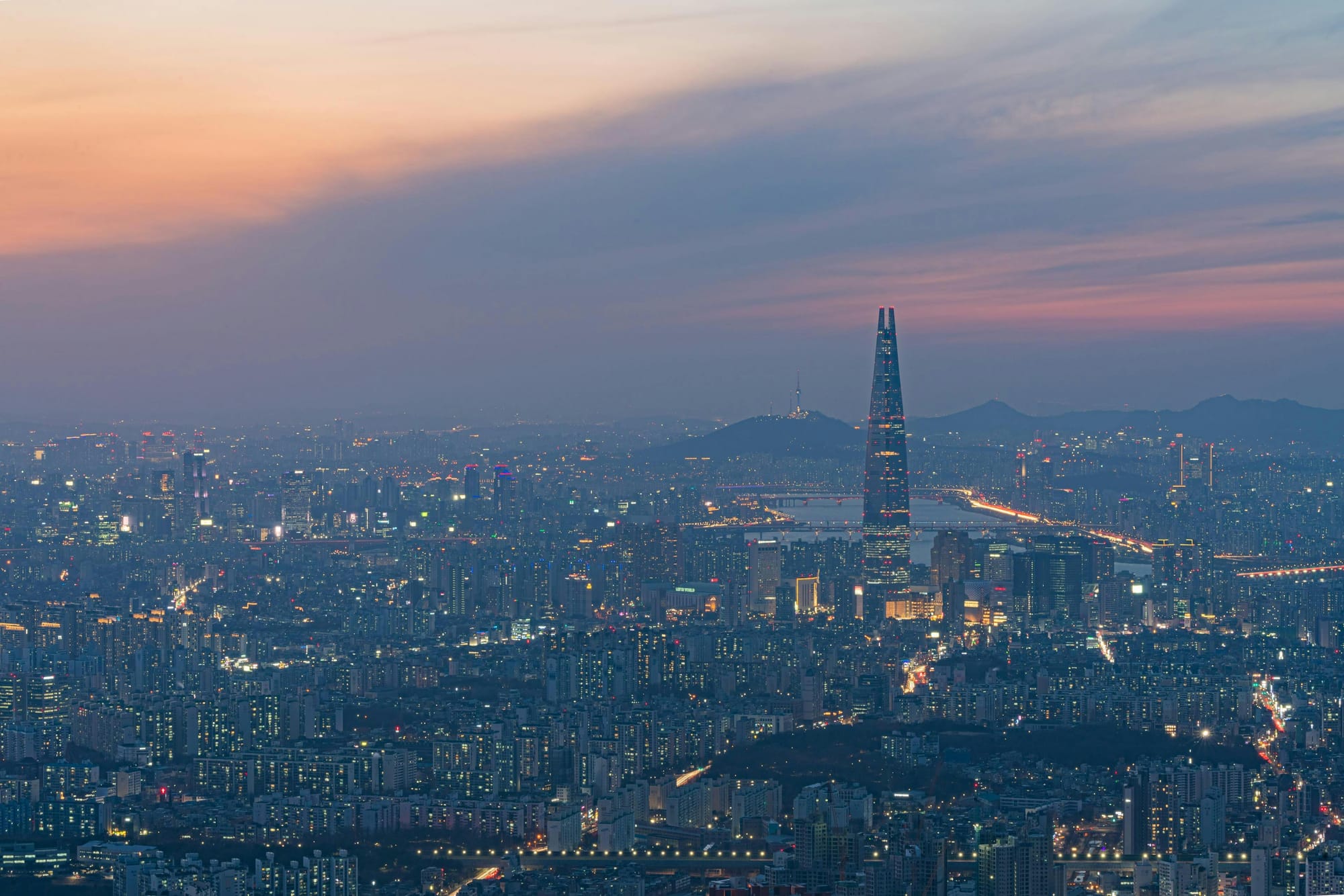
As this system matured, Seoul became the country’s administrative and corporate center. Ministries, regulators, banks, global headquarters, and research institutions are concentrated in one extended metropolitan area. Today, the Seoul Capital Area accounts for roughly half of Korea’s population and about half of its GDP. Most major corporate headquarters — from semiconductors and batteries to automotive design, heavy industry, and digital platforms — operate from Seoul or its immediate surroundings.
Seoul functions as the command center of Korea’s entire industrial network. Decisions on investment, product development, export strategy, and global partnerships originate in the capital. For most foreign firms, understanding Korea means understanding Seoul, because the country’s economic system is directed from one place.
Industrial Structure
Korea’s industrial model relies on tightly linked manufacturing ecosystems. The chaebol structure connects different industries inside the same corporate groups — for example, Hyundai is active in automotive production, shipbuilding, steel, engine manufacturing, and logistics. This internal integration reduces friction between suppliers and producers and allows companies to scale quickly when global demand shifts.
Seoul coordinates this system. Corporate strategy units, research centers, financing divisions, and planning teams sit within a compact radius. When global markets change — for example, rising demand for semiconductors, batteries, or LNG carriers — Korean firms can reorganise supply chains and commit investment from a single decision hub.
This concentration is why Seoul remains one of the most comprehensive industrial centers in Asia: a place where hardware, materials, design, exports, and technology converge in one metropolitan system.
Semiconductors
Korea is one of the world’s leading players in semiconductors. The country produces about 15 percent of the world's semiconductors, ranking third globally behind China and Taiwan, but it is the top producer in the global memory-chip industry. Korean firms produce about 60 percent of the world’s memory semiconductors, including 70 percent of global DRAM and roughly 50 percent of global NAND flash.
DRAM is the short-term working memory used in phones, computers and servers. It stores the data devices need immediately, allowing apps and operating systems to run smoothly. NAND flash is long-term storage memory used in solid-state drives, memory cards and most consumer electronics. It retains files, photos, apps and system data even when the device is turned off.
Almost every digital device depends on these two components. Smartphones use DRAM to manage active tasks. Laptops, tablets and game consoles use NAND flash to store applications and user data. Cloud platforms such as Amazon Web Services, Google Cloud and Microsoft Azure rely on large volumes of DRAM and NAND to operate their data centers.
The industry is led by Samsung Electronics and SK Hynix, whose global-strategy teams, research labs and partnership units are based in the Seoul region. Their customers include major smartphone producers such as Apple and Xiaomi, PC manufacturers such as Dell and Lenovo, and cloud-service platforms. Korean chips sit inside nearly every tier of the world’s computing and digital-service ecosystem.
Korea also leads in high-bandwidth memory (HBM) — specialised chips designed for heavy data workloads. Korea supplies around half of global HBM output. These chips are built by stacking multiple memory layers vertically to increase data-transfer speed and capacity. They are used in high-performance processors within advanced data-center systems and are supplied to major hardware companies operating in the high-end computing segment.
While Korea dominates the global memory-chip segment, that category represents only about one-fifth of the total semiconductor market. In non-memory products — such as logic chips and mobile processors — Korea holds roughly 2% of global output and around 10–15% of foundry production, compared with Taiwan’s TSMC, which exceeds 50%. To address this imbalance, the government has launched a multi-year support program aimed at raising Korea’s non-memory share toward 10% by 2030. The plan includes a $470 billion semiconductor cluster in Gyeonggi Province, targeted incentives for advanced logic production, and expanded R&D support for AI-oriented chip design.
Although fabrication plants are distributed across the country, all high-level coordination — investment decisions, global negotiations, product roadmaps and research strategy — is managed from Seoul.
Batteries
Batteries constitute the second major pillar of Korea’s high-tech export sector. Korea ranks as the second-largest battery producer, holding a market share of 18 percent in the global electric-vehicle battery market, making the country one of the key suppliers outside of China, which has 70% market share.
Production is led by LG Energy Solution, SK On and Samsung SDI. These companies manufacture lithium-ion cells for electric vehicles, stationary energy-storage systems and premium consumer electronics. Their batteries are used by global carmakers and energy operators integrating renewable power into national grids.
As with semiconductors, strategic direction and international partnership management sit in Seoul. Headquarters coordinate export contracts, research programs, materials procurement and new production sites abroad.
Korea’s battery sector benefits from close proximity to its automotive and electronics industries, allowing firms to integrate design, testing and manufacturing across multiple product categories.
Automotive
The automotive industry is one of Korea’s oldest and most globalised export sectors. Hyundai Motor Group — which includes Hyundai and Kia — supplies vehicles to major markets across North America, Europe, the Middle East and Asia. Korean manufacturers produce models in every category, including a growing range of electric vehicles.
Research from the Friedrich-Ebert-Stiftung notes that Korean carmakers can adapt to new technologies quickly because key functions — design, components, electronics and powertrain development — are integrated across the same corporate network. This structure reduces delays when reorganising supply chains or shifting toward electric-vehicle platforms.
Most strategic functions, including product planning, design centers, export teams and global-partnership units, operate from the Seoul region.
Shipbuilding
Korea is one of the world’s major shipbuilding centers, second only to China. In 2023, China, Japan and the Republic of Korea together produced around 95 percent of global shipbuilding output, with China accounting for more than half of all newly delivered capacity.
Korean shipyards build a wide range of commercial vessels for customers across Asia, Europe and the Middle East. Their output includes container ships, oil tankers, and LNG carriers — segments that demand large-scale engineering, long production cycles and strict safety certification. Companies such as Hyundai Heavy Industries, Samsung Heavy Industries, and Hanwha Ocean hold significant global share in high-value ships where precision manufacturing and system integration matter most.
LNG carriers are a core specialty. These vessels require complex cryogenic containment systems (tanks that hold gas at extremely low temperatures) and specialized steel grades designed to prevent cracking under thermal stress. Korean yards have long-standing advantages in these technologies, supported by training pipelines, established supplier networks and decades of operational experience. By 2023, South Korean builders accounted for around 60 percent of global LNG-carrier orders.
Most shipyards are located along Korea’s southern coastline, but strategic investment decisions, export coordination and research programs are centered in Seoul. This structure links industrial production in the coastal regions with national planning, finance and technology development in the capital.
Steel & Materials
Steel is a core industrial input for Korea’s manufacturing economy. The country is home to POSCO and Hyundai Steel, both major global producers supplying materials for shipbuilding, automotive manufacturing, construction and heavy machinery.
POSCO produced 38.6 million tonnes of crude steel in 2022, placing it among the world’s top six steel producers. Industry publications also rank POSCO as the world’s most competitive steelmaker due to its quality range and export scale.
Korean producers specialise in high-grade steels for ship hulls, automotive bodies, LNG-carrier tanks and industrial equipment. Hyundai Steel integrates production directly with Hyundai Motor Group’s vehicle manufacturing, linking raw materials to finished cars within the same industrial ecosystem.
Strategic planning and international sales functions are based in Seoul, where corporate headquarters coordinate export contracts and investment decisions.
Electronics & ICT
Electronics are one of Korea’s most recognised export categories. Samsung Electronics and LG Electronics operate global product lines in home appliances, displays and consumer devices. These companies benefit from proximity to Korea’s semiconductor and materials industries, enabling integrated development from component to final product.
Korea also maintains strong digital-infrastructure capabilities. Early nationwide broadband investment supported the rise of domestic technology firms such as Naver and Kakao, which operate search engines, messaging platforms and digital-service ecosystems used by millions.
In consumer goods, Korea has established a global presence in high-quality skincare and cosmetic products, exporting to markets across Asia, Europe, and North America, and ranking as the third largest in the world. These products reflect advanced manufacturing standards and research-driven formulations.
As with other sectors, headquarters and strategic teams for electronics, ICT and cosmetics operate from the Seoul region.
Defense Industry
South Korea occupies a central position in Northeast Asia’s security architecture. The country hosts a permanent U.S. military presence through U.S. Forces Korea (USFK) and maintains treaty-level cooperation with the United States. Coordination includes joint training, shared research programs and systems such as THAAD and Patriot missile defense.
Korea is one of the world’s largest importers of U.S. defense equipment, with procurement, financing and inter-governmental coordination managed through ministries and institutions headquartered in Seoul.
At the same time, Korea has expanded its own defense-manufacturing capabilities. Platforms such as the K2 main battle tank, K9 self-propelled howitzer and FA-50 light combat aircraft have been exported to several countries. These programs are directed by defense companies based in the Seoul Capital Area and supported by research institutes, procurement agencies and command structures located in and around the city.
Korea’s position between the Korea Strait and the Yellow Sea, combined with constant readiness requirements due to North Korea, reinforces Seoul’s role as the center of defense planning and industrial development.
Business Access
South Korea actively engages with foreign companies. Many countries maintain Chambers of Commerce in Seoul, including the United States, Germany, France, the United Kingdom, Japan and Canada. These chambers provide structured access points for firms entering the Korean market.
They maintain databases of local companies, organise sector briefings and arrange B2B meetings. Their role is systemic rather than promotional: they offer predictable mechanisms for identifying partners, understanding regulatory environments and navigating Korea’s concentrated industrial structure.
This institutional network aligns with Korea’s export-oriented economy and supports the flow of international firms into Seoul’s manufacturing and technology sectors.
Hospitality Infrastructure
Seoul’s concentration of corporate activity is supported by an extensive hospitality and services network. Hotels, dining areas and meeting venues are situated close to major business districts, allowing visitors to manage schedules efficiently across short distances.
The Grand Hyatt Seoul for example is located in the city’s international corridor between Itaewon, Hannam-dong and Yongsan — areas with embassies, consulates, expatriate communities and professional-service firms. Its position provides direct access to key commercial zones and minimises travel time for meetings.
The hotel features a spacious lobby and coffee area suitable for informal discussions or quick meetings with clients or colleagues, meeting rooms for 6 to 16 people, and a multi-purpose event hall of over 1,200 m² that can be used for corporate gatherings, B2B meetings, and presentations—facilities such as the fitness center, pool and spa support visitors managing long travel itineraries.
Nearby districts offer a wide range of dining options. Traditional restaurants near Itaewon-ro and the adjoining fashion streets allow for casual lunches with partners, while the wider neighborhood includes international and premium venues for formal dinners. This mix allows companies to adjust the tone of each engagement while remaining within a compact area.
The surrounding environment also provides convenience for business visitors traveling with family- cafés, parks, and cultural spaces are all located nearby.
Conclusion
Seoul is the focal point of South Korea’s industrial, technological and strategic system. The capital concentrates ministries, financial institutions, research centers and the decision-making structures of every major export industry.
Semiconductors, batteries, automotive production, shipbuilding, steel, electronics, ICT services and defense manufacturing are coordinated from the city’s metropolitan area, creating a single command network that links design, production, logistics and global partnerships.
For companies entering the Korean market, Seoul provides a clear institutional framework through foreign Chambers of Commerce, predictable regulatory channels and an integrated hospitality infrastructure suited to business travel. Everything — industrial capability, government coordination, and operational convenience — converges in one location.
This combination makes Seoul one of the most complete and concentrated business environments in Asia: a city where global supply chains, advanced manufacturing and international partnerships intersect within a single, coordinated system.
Sources:
https://www.investkorea.org/ik-en/cntnts/i-3025/web.do
Industry_Discover_Semiconductor.pdf
LNG Shipping: Short-Term Headwinds, Long-Term Growth | Clarksons
Review of Maritime Transport 2024 | UN Trade and Development (UNCTAD)
Hyundai Motor Group Commits to U.S. Growth with USD 21 Billion Investment - Hyundai Newsroom
South Korea - Information and Communication Technology
South Korea Household Appliances Market Size Report, 2030
South Korea’s cosmetic industry ranks third globally as exports reach US$10B milestone
U.S. Security Cooperation With ROK - United States Department of State